

Five Ways Clubs Lose Money Without Knowing It
Most swim clubs leak thousands in revenue each season. Learn five hidden profit drains and practical fixes to recover revenue now.


Your treasurer just sent the quarterly report, and something doesn't add up. You have 240 active memberships, but the revenue looks light. You know families are using the pool every weekend, yet somehow the numbers don't match the activity you're seeing. This disconnect happens at swim clubs everywhere, and most boards don't realize they're losing thousands of dollars each season to small, fixable problems. The good news? Once you know where to look, you can recover revenue that's already yours.
Let's walk through the five most common places clubs lose money and exactly how to fix each one.
Failed Payments That Never Get Collected
Here's a scenario you've probably seen: A family's credit card expires in March. Your billing system tries to charge their April dues and fails. The system sends an automated email, but the family is busy with spring break and doesn't see it. By June, they owe three months of dues plus late fees, and now you're in an awkward position. Do you chase them? Let it slide? Either way, you've lost revenue.
Failed payments are the biggest silent profit drain at member-driven facilities. When a payment bounces, every day you wait reduces your chance of recovery.
Why Payments Fail More Often Than You Think
Most clubs assume failed payments are rare. In reality, subscription businesses report that 4-8% of recurring charges fail each month. For a 200-member swim club charging $100/month, that's potentially $800-$1,600 in failed transactions every single month.
Payments fail for dozens of reasons:
- Credit cards expire (happens to everyone eventually)
- Banks flag legitimate charges as suspicious
- Members change cards after fraud alerts
- Insufficient funds on payment day
- Outdated billing information on file
The problem isn't the initial failure. It's what happens next. Research on combating involuntary churn shows that most businesses lose 20-40% of customers who experience a payment failure, simply because they lack a systematic recovery process.
Building a Recovery System That Works
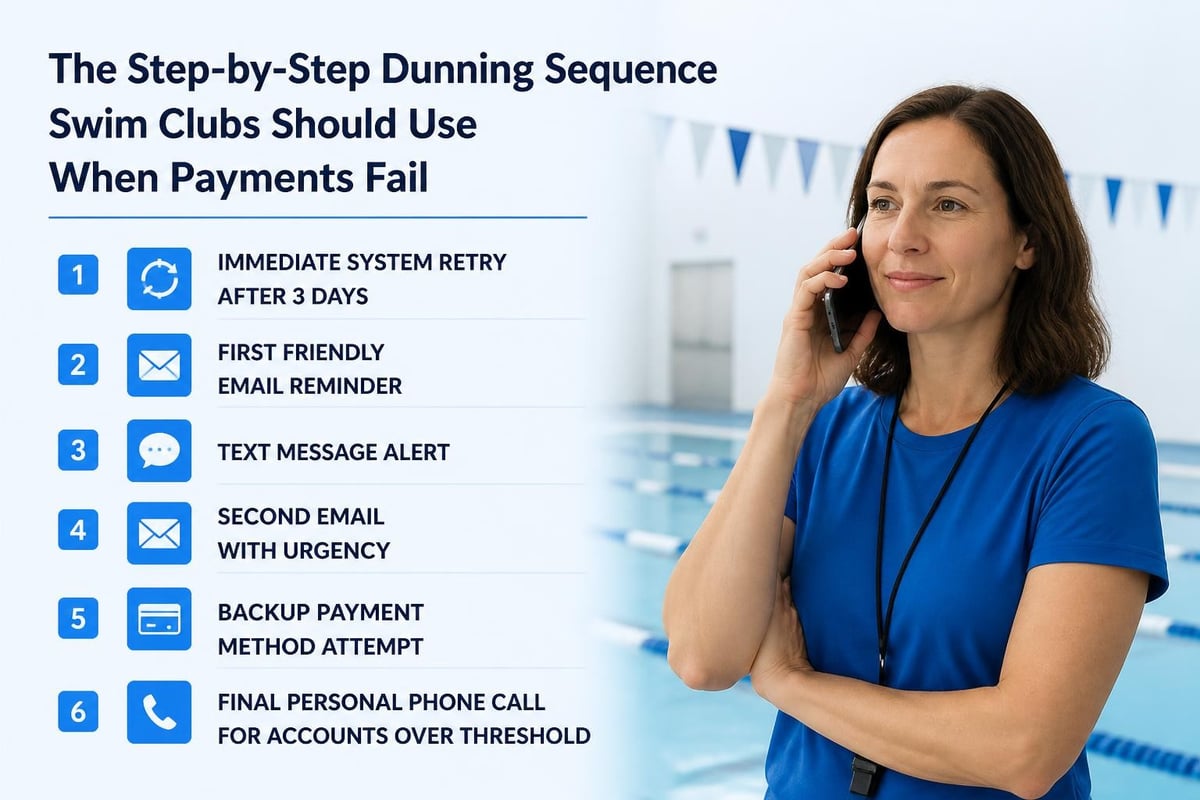
To recover revenue from failed payments, you need a system, not a scramble. Here's what actually works:
Immediate retry logic: Try the payment again 3-5 days later. Many failures are temporary (bank systems down, daily limit reached), and a simple retry captures 15-25% of failed payments automatically.
Smart dunning sequences: Send a series of emails and texts over 7-14 days. Start friendly ("Hey, we couldn't process your payment"), escalate gradually ("Your account needs attention"), and always make it easy to update payment info with a direct link.
Multiple payment methods on file: Ask members to keep a backup card or bank account on file. When the primary method fails, try the backup before alerting the member.
Personal outreach for high-value accounts: If a family owes $500+, pick up the phone. A 60-second call recovers more revenue than three automated emails.
A modern swim club management platform should handle most of this automatically, sending the right message at the right time and updating you only when human intervention is needed.
Manual Billing Errors That Add Up Fast
Every swim club has a story about the membership that was charged $75 instead of $175 for six months straight. Or the family that somehow never got billed at all. These errors happen when humans touch billing, and they're costing you more than you realize.
Manual billing is like trying to count a bucket of marbles while someone keeps adding more. Eventually, you lose track.
The Real Cost of Spreadsheet Management
Let's say you manage 180 memberships using spreadsheets and manual processes. You're updating membership levels, applying seasonal rates, tracking guest passes, and managing family discounts. Even with perfect attention to detail, you'll make 2-3 billing errors per month. That might not sound like much, but here's the math:
| Error Type | Frequency | Average Loss | Annual Impact |
|---|---|---|---|
| Incorrect rate charged | 1x/month | $45 | $540 |
| Missed billing cycle | 1x/quarter | $175 | $700 |
| Guest fees not collected | 2x/month | $15 | $360 |
| Proration errors | 4x/season | $60 | $240 |
| Total Annual Revenue Loss | $1,840 |
That's $1,840 per year from a small club with just one part-time admin. Scale that to a larger facility with multiple membership tiers, family discounts, seasonal rates, and sibling pricing, and you're easily losing $5,000-$10,000 annually.
Automation Prevents Errors Before They Happen
The solution isn't trying harder or double-checking everything. It's removing the opportunity for human error. Revenue automation tools handle the complexity:
- Rate cards: Set up your pricing structure once, and the system applies the right rate to every member, every time
- Rule-based billing: "If membership = Family and month = Summer, charge $X" runs automatically
- Prorated calculations: Mid-month joins and cancellations get calculated correctly without spreadsheet formulas
- Audit trails: Every charge has a timestamp and reason, so you can trace any discrepancy
When you move from manual billing to automated systems, you don't just save time. You recover revenue that was slipping through calculation errors, missed charges, and forgotten guest fees. The benefits of revenue automation extend beyond accuracy to faster collections and better cash flow visibility.
Expired Memberships Falling Through Renewal Cracks
June hits, and thirty memberships are up for renewal. You send a mass email in May reminding everyone. Twenty-three renew. Seven don't respond. What happens to those seven?
In many clubs, those seven families just... disappear. They might have intended to renew but got busy. Maybe they didn't see the email. Perhaps they were waiting for their spouse to make the decision. Whatever the reason, you just lost $10,000-$15,000 in annual revenue because there was no follow-up system.
Why Passive Renewal Processes Fail
The old model was simple: Membership expires, send a reminder, wait for the member to act. This works for highly motivated members but fails for the middle 40% who are interested but distracted.
Think about your own subscription services. How many do you keep paying for simply because canceling requires effort? That's not manipulation; it's friction working in favor of continuity. Swim clubs often create the opposite: friction that makes renewal harder than lapsing.
Common renewal friction points:
- Renewal notices sent only once, weeks before expiration
- No clear call-to-action or easy payment link
- Multi-step processes (print form, write check, mail or drop off)
- No reminder on actual expiration day
- Zero follow-up after expiration
A comprehensive guide on running re-engagement campaigns shows that win-back sequences can recover 5-15% of lapsed customers, which for a swim club translates directly to recovered membership revenue.
A Renewal Timeline That Actually Works
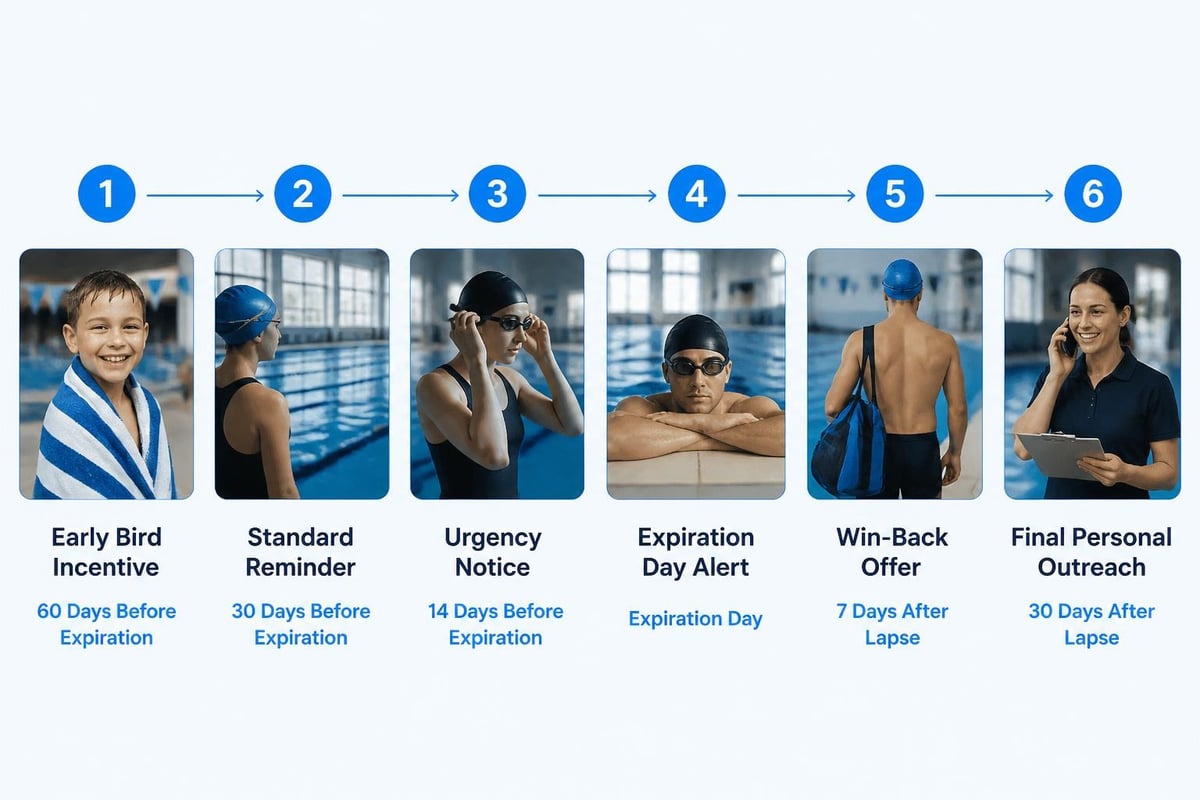
Here's a proven renewal sequence that keeps more members active:
60 days before expiration: Early bird reminder with incentive (renew now, get August free)
30 days before: Standard renewal notice with benefits reminder and easy renewal link
14 days before: Urgency message ("Don't lose your pool access") with one-click renewal
Expiration day: "Today's your last day" message with extended deadline option
7 days after expiration: Win-back offer ("We miss you! Renew this week, no late fee")
30 days after expiration: Final outreach with special offer or call from board member
This sequence doesn't feel pushy because each message provides value or solves a problem. You're making renewal easier, not pestering people. The result? Most clubs implementing structured renewal sequences see 15-25% fewer lapses and recover revenue from members who simply needed a nudge.
Administrative Time That Could Be Collecting Money
Your pool manager spends six hours every week on tasks that don't directly serve members or generate revenue: answering "what's my balance" emails, tracking down payment confirmations, updating spreadsheets, fixing duplicate member records, and researching billing questions.
That's 312 hours per year. If we value that time at just $25/hour (probably low for an experienced manager), you're spending $7,800 annually on administrative busywork.
Now, what if those six hours went toward proactive revenue recovery instead?
The Opportunity Cost of Manual Administration
When your staff is buried in routine tasks, they can't focus on activities that actually recover revenue or grow membership:
- Calling families with past-due balances
- Reaching out to last season's members who haven't renewed
- Following up on incomplete registrations
- Processing waitlist members when spots open
- Planning retention events for at-risk members
The math is simple: Every hour spent on routine admin is an hour not spent on revenue-generating activities. If your manager can recover just $100/hour through focused collection and retention work, those six weekly hours represent $31,200 in annual revenue opportunity.
How AI and Automation Free Up Revenue-Generating Time
Modern swim club software handles the busywork automatically:
- Members check their own balances through a portal (no more emails)
- Payment confirmations go out automatically (no manual tracking)
- System flags accounts needing attention (no spreadsheet hunting)
- Duplicate detection happens in real-time (no cleanup projects)
- Billing questions get answered by searchable transaction history
This isn't about replacing people. It's about letting people do the work that actually matters. When routine questions are handled by self-service tools and AI-powered insights flag the accounts that need human attention, your staff can focus on the personal touchpoints that retain members and collect outstanding balances.
One club administrator told us she recovered $8,400 in past-due accounts during her first month with automation, simply because the system gave her time to make collection calls she'd been putting off for months.
Chargebacks and Disputes You Don't Contest
A member cancels their credit card after their daughter's swim lessons end in August. In October, you process their annual dues. The charge goes through (you have the card on file from registration), but the member disputes it as "unauthorized." The bank reverses the charge, and you lose $200 plus a $25 chargeback fee.
You could contest it. You have their signed agreement. But is it worth the time? Most clubs let it go.
Do that ten times a season, and you've lost $2,250 in revenue that was legitimately owed.
Understanding the Chargeback Problem
Chargebacks exist to protect consumers from fraud, but they're often misused by members who regret a purchase or don't recognize a charge. The overview of chargebacks and prevention strategies from Visa shows that "friendly fraud" (legitimate charges disputed by cardholders) accounts for up to 75% of all chargebacks in subscription businesses.
For swim clubs, common chargeback scenarios include:
- Member doesn't recognize your billing descriptor on their statement
- Family cancels card after summer ends, forgets about fall dues
- Dispute filed instead of calling you to request a refund
- Member claims they "never agreed" to recurring billing
Each chargeback costs you the transaction amount plus fees ($15-$100 depending on your processor). More importantly, high chargeback rates can increase your processing fees or even get your merchant account terminated.
Fighting Back (The Right Way)
You should contest every chargeback where you have documentation. The success rate for merchants who submit compelling evidence is 40-60%, which means you'll recover revenue on nearly half of disputed charges.
To win chargebacks, you need:
- Clear billing descriptors: Use a name members recognize on statements
- Signed agreements: Electronic signatures on membership terms
- Communication records: Proof you sent bills and reminders
- Service delivery proof: Check-in records showing the member used facilities
- Cancellation policy documentation: Clear terms acknowledged at signup
Modern swim club management software stores all this documentation automatically. When a chargeback hits, you're not scrambling through email archives and filing cabinets. You're clicking "export evidence" and submitting a package that includes the signed agreement, check-in history, billing notices sent, and terms acknowledged.
Prevention is even better. Clear communication, recognizable billing descriptors, and confirmation emails for every charge reduce chargebacks by 60-80%. When members know exactly what they're being charged and why, disputes become rare.
The FTC business guidance on debt collection also reminds us that while recovering owed revenue is legitimate, all collection activities must comply with fair practice regulations and member rights.
Putting It All Together: Your Revenue Recovery Action Plan
You've now seen the five biggest places swim clubs lose money. The question is: what do you do Monday morning?
Here's a practical 30-day action plan to start recovering revenue:
Week 1: Audit Your Current State
Day 1-2: Pull a report of all failed payments in the last 90 days. Calculate total dollars lost.
Day 3-4: Review your billing accuracy. Compare your membership roster to actual charges sent. Find discrepancies.
Day 5-7: Identify expired memberships from last season. Count how many never renewed and estimate revenue lost.
| Audit Area | What to Measure | Target to Find |
|---|---|---|
| Failed payments | Dollar value of bounced charges | Total recoverable amount |
| Billing errors | Members charged wrong amount | Revenue under-collected |
| Lapsed renewals | Members who didn't renew | Lost annual revenue |
| Administrative time | Hours/week on routine tasks | Time available for recovery |
| Chargebacks | Disputes in last 12 months | Contestable losses |
Week 2: Implement Quick Wins
Failed payments: Set up a basic dunning sequence using your current email tool. Even a simple "Your payment failed, please update" message sent 3, 7, and 14 days after failure will recover 20-30% of lost revenue.
Billing errors: Fix the errors you found. Send makeup invoices for under-charged accounts with a courteous note explaining the correction.
Lapsed memberships: Create a win-back email for last season's members who didn't renew. Offer a limited-time incentive ("Rejoin by month-end, get 15% off").
Week 3-4: Build Long-Term Systems
Evaluate your tools: If you're managing billing and renewals through spreadsheets and manual processes, you'll keep losing revenue to the same problems. Look at whether your current system can automate dunning, renewals, and accuracy checking. PoolPulse's features are specifically designed to plug these revenue leaks automatically.
Create standard operating procedures: Document your new recovery processes so they happen consistently, not just when someone remembers.
Train your team: Make sure everyone who touches billing or member communication understands the revenue recovery systems.
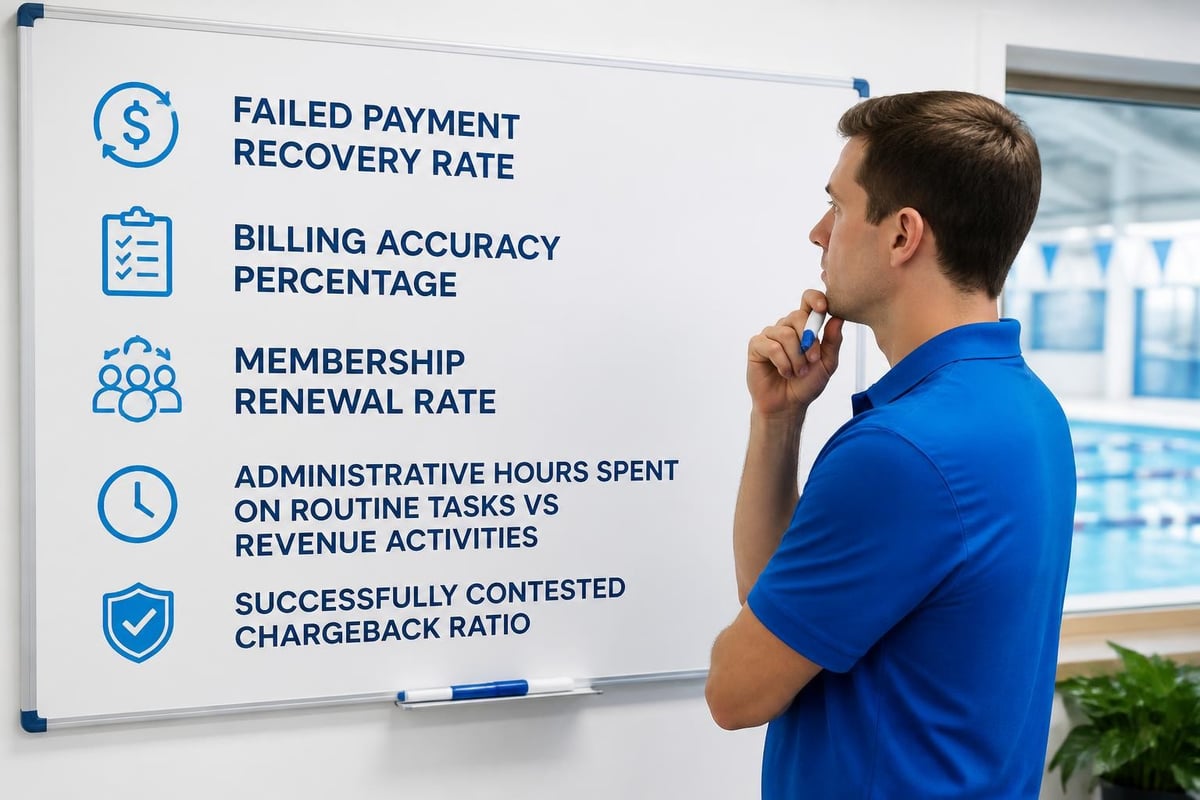
Set up monitoring: Create a simple dashboard showing failed payment recovery rate, billing accuracy, renewal rate, and time spent on admin tasks. Review monthly.
What Recovered Revenue Actually Looks Like
Let's put real numbers to these strategies. Imagine a 200-member swim club with average annual dues of $1,500 per family:
Failed payment recovery: Reduce uncollected failed payments from 6% to 2% = $18,000 recovered annually
Billing error elimination: Fix systematic under-charging and missed charges = $8,000 recovered annually
Improved renewal rate: Reduce lapses from 18% to 10% through better communication = $24,000 in retained revenue annually
Reduced chargebacks: Contest 50% of disputes with 50% success rate = $1,200 recovered annually
Administrative efficiency: Redirect 4 hours/week from busywork to proactive collection = $12,000 in collected past-due accounts
Total impact: $63,200 in recovered and retained revenue in year one.
For most swim clubs, that's the difference between operating in the red and having a healthy reserve fund. It's the difference between deferring pool maintenance and investing in facility improvements. It's the difference between raising dues again and keeping rates stable.
The best part? This isn't new revenue you have to chase. It's money you've already earned that was slipping away due to preventable administrative gaps.
Making Revenue Recovery Part of Your Culture
The biggest mistake clubs make is treating revenue recovery as a one-time project. You audit, fix problems, and move on. Six months later, the same issues have crept back in.
Lasting change requires building recovery into your regular operations:
Monthly revenue reviews: Don't just look at total revenue. Review recovery metrics, failed payments, renewal rates, and collection progress.
Accountability assignments: Someone owns each revenue stream and reports monthly on health and recovery efforts.
Technology that works for you: Tools should surface problems automatically, not require you to go hunting. If you're spending hours creating reports to find issues, you need better software.
Member communication standards: Every failed payment, upcoming renewal, and past-due balance triggers a specific, timely communication. No exceptions.
Continuous improvement: Each quarter, pick one revenue leak to improve. Over a year, you'll systematically close every gap.
Understanding how to effectively manage a swim club includes developing these operational disciplines alongside your programming and facility management.
The Technology Question Every Club Faces
At some point, every swim club administrator faces this decision: Keep patching together spreadsheets, email tools, and payment processors, or invest in a unified platform that handles the complexity?
There's no universal right answer, but there is a calculation you can make. Add up:
- Revenue you're losing to the five gaps outlined above
- Time you're spending on manual administration (valued at your hourly cost)
- Member frustration from billing errors and poor communication
- Risk of data errors, security issues, and compliance problems
Compare that total to the cost of modern club management software. For most clubs, the software pays for itself in recovered revenue within 2-3 months.
Beyond the financial math, there's a quality-of-life question. Do you want to spend your time hunting through spreadsheets and chasing failed payments, or would you rather focus on member experience, program quality, and facility improvements?
The clubs that successfully recover revenue year after year are the ones that treat revenue operations as seriously as they treat pool chemistry and safety. They invest in systems, train their teams, and monitor metrics consistently.
Revenue recovery isn't about squeezing members or nickel-and-diming families. It's about getting paid for the value you're already providing and operating your club like the serious business it is. When you plug the leaks outlined in this article, you'll find thousands of dollars you didn't know you were losing and free up hours you didn't know you had. PoolPulse was built specifically to help swim clubs, HOA pools, and member facilities automate revenue recovery, eliminate billing errors, and spend less time on administration so you can focus on what matters: running a great club that members love.

Five Front-Desk Tasks Your Swim POS Should Handle
Your front desk shouldn't need three systems to check in a swimmer. Here's how modern swim POS systems save time and reduce errors.

The Swim Club Software Test Every Board Should Run
Run this simple test to see if your swim club software actually saves time or creates more work. Real scenarios, honest questions, better tools.

The Seven Signs You've Outgrown Your Club Operations
Your swim club is growing, but your tools aren't keeping up. These seven warning signs reveal when manual processes cost more than solutions.
Want to see if PoolPulse is a good fit for your club?
Book a walkthrough and we'll show you exactly how PoolPulse can help based on your club's needs, goals, and current processes.