

Managing Your Membership: A Club Admin's Guide
Learn how to manage your membership effectively with practical tips for swim clubs, HOAs, and member facilities on billing, renewals, and engagement.


Managing members at a swim club isn't just about collecting dues and unlocking gates. Your membership data touches everything from daily operations to long-term planning. When you're juggling hundreds of families, tracking who's paid, who's on a waitlist, and who needs their access card replaced, things get complicated fast. The way you handle your membership can make the difference between smooth summers and constant firefighting.
Understanding What Your Membership Really Means
Your membership isn't just a list of names in a spreadsheet. It's a living, breathing collection of families who expect access, service, and value. Every member represents recurring revenue, sure, but they also represent unique needs, different membership types, and varying levels of engagement with your facility.
Think about it. You've got year-round members, summer-only members, social members who only come for events, and corporate memberships that cover multiple families. Each type has different billing cycles, different access privileges, and different expectations. When you're tracking all this manually or in disconnected systems, mistakes happen.
The Real Cost of Poor Member Tracking
I've seen clubs lose thousands of dollars because they couldn't track membership status accurately. Someone's payment failed in March, but they kept swimming until July because nobody caught it. Or a family cancelled in writing, but the gate access never got turned off, and the billing kept running.
These aren't rare edge cases. They happen all the time when your membership data lives in three different places:
- Financial records in QuickBooks
- Access control in a separate gate system
- Member contact info in email or Google Sheets
- Event registrations in yet another tool
When systems don't talk to each other, information falls through the cracks. You end up doing the same data entry multiple times, and you still can't trust that everything's accurate.
Setting Up Your Membership Structure
Before you can manage your membership effectively, you need to decide how to structure it. This isn't about picking the right software yet. It's about understanding your club's specific needs and how different member types should work.
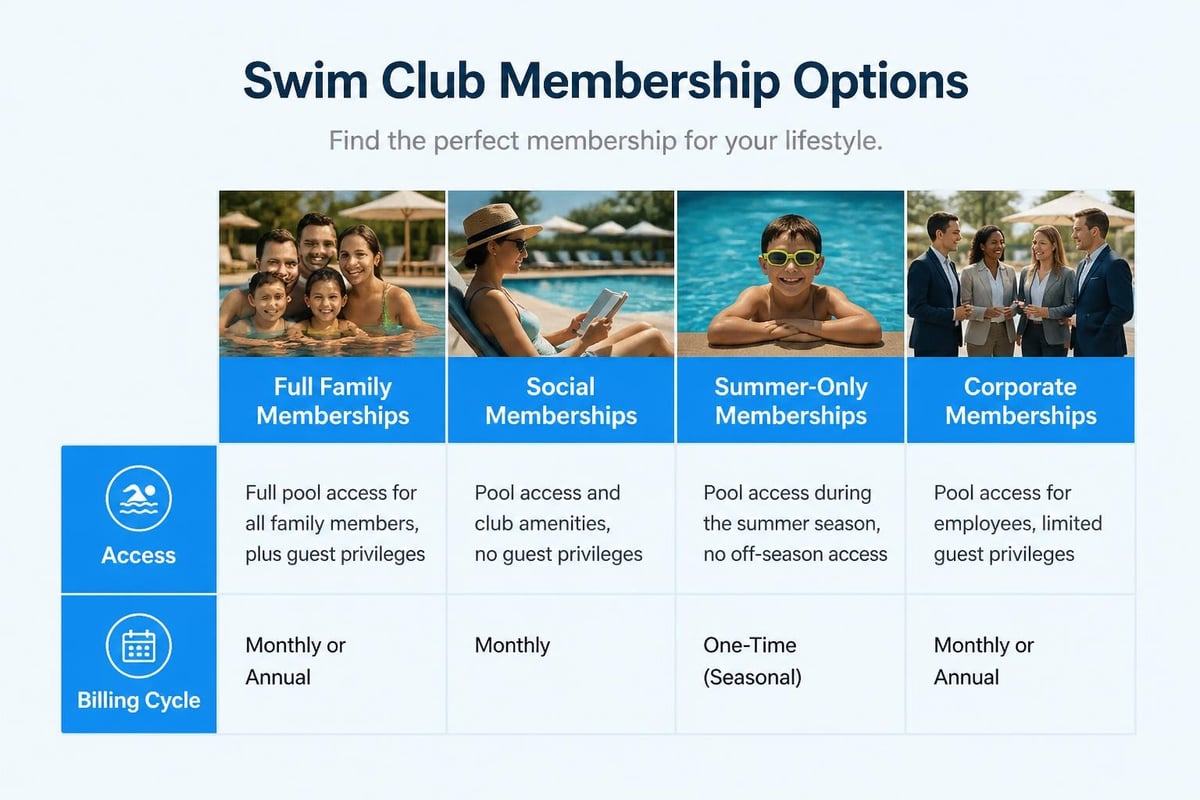
Start by mapping out every membership type you offer. For each one, write down:
- What access does this membership include?
- How much does it cost, and when do we bill?
- Are there any special rules or limitations?
- What happens at renewal time?
- Can members upgrade or downgrade mid-season?
This exercise sounds basic, but you'd be surprised how many clubs discover inconsistencies. Maybe the board approved a new membership tier three years ago, but half the staff doesn't know it exists. Or the bylaws say one thing, but the practice has drifted over time.
Making Membership Types Work in Practice
Once you've documented your membership structure, you need systems that can actually enforce it. Your membership management needs to handle real-world scenarios, not just the perfect cases.
What happens when a family wants to pause their membership for medical reasons? Can your system handle that without deleting their entire record? What about families who need payment plans instead of paying the full annual fee upfront?
| Scenario | Manual Tracking | Integrated System |
|---|---|---|
| Failed payment | Might not notice for weeks | Automatic notification same day |
| Access expiration | Staff manually deactivates | Auto-expires based on membership dates |
| Upgrade request | Multiple database updates | Single change updates billing and access |
| Family adds a guest | Paper sign-in, manual follow-up | Digital check-in with automatic guest tracking |
The right approach to your membership structure makes daily operations smoother and reduces the number of exceptions your staff has to handle manually.
Billing and Your Membership Revenue
Let's talk money. Your membership billing directly impacts cash flow, and most clubs live or die based on how well they collect dues. If you're still sending paper invoices or manually processing checks, you're making life harder than it needs to be.
Automated billing for your membership isn't just convenient. It's essential for predictable revenue. When members have credit cards on file and payments process automatically, your collection rate goes up dramatically. You're not chasing people down or wondering if this month's bills got paid.
The Renewal Challenge
Membership renewals are where clubs often lose money. A family's membership expires, but there's no clear process for renewal. Maybe they get an email, maybe they don't. Maybe it goes to an old email address that nobody checks anymore. The family fully intends to renew, but life gets busy, and suddenly they've missed the deadline.
Now what? Does your membership system let them renew online instantly? Or do they have to call the office, leave a message, wait for a callback, and mail a check? The more friction in the renewal process, the more members you'll lose to simple procrastination.
Smart clubs build renewal reminders into their membership workflow:
- 60 days before expiration: First reminder email
- 30 days before: Second reminder with direct renewal link
- 14 days before: Final notice with any late fee warnings
- Day of expiration: Access paused, payment required to reactivate
This isn't being pushy. It's helping people stay current so they don't lose access unexpectedly.
Managing Access and Your Membership Status
Your membership status should directly control facility access. This seems obvious, but it breaks down at many clubs. The gate system doesn't know who's paid up. Staff have to manually check lists. Members get frustrated when their card doesn't work, even though they paid last week.
Real-time integration between your membership records and access control saves everyone headaches. When someone's payment processes, their gate access should activate immediately. When their membership lapses, access should turn off automatically.

Guest Management and Your Membership
Guests are another layer of complexity. Most memberships include some number of guest visits, but tracking them manually is a nightmare. Did the Smith family already use their four guest passes this month? Good luck finding that information quickly when they're standing at the front desk.
Your membership management should track guest usage automatically:
- How many guest visits are included
- How many have been used this period
- Whether additional guests require payment
- Any seasonal restrictions on guests
This protects both your club and your members. Members don't accidentally exceed their limit and get surprised by charges. You don't lose revenue from unlimited guest visits that should have been paid.
Communication and Your Membership Experience
How you communicate with members shapes their entire experience with your club. Your membership database should be the single source of truth for who gets which communications. You need to be able to filter members by type, status, interests, or any other criteria that matters.
Sending the wrong email to the wrong members damages trust. Social members don't care about swim team practice schedules. Year-round members don't need summer opening reminders. When every member gets every message, they start tuning you out.
Segmentation based on your membership data lets you send relevant communications:
- Pool closing notices only to active members
- Renewal reminders only to those expiring soon
- Event invitations based on membership tier
- Billing notices only to those with payment issues
This targeted approach respects people's time and keeps your messages from ending up in spam folders.
Keeping Member Information Current
Your membership data quality degrades over time. People move, change email addresses, get new phone numbers. If you're only asking for updated information at annual renewal, you're missing changes for months at a time.
Make it easy for members to update their own information. A member portal where people can log in, change their email, add a new family member, or update emergency contacts keeps your database accurate without staff intervention.
The swim club member management software you choose should make self-service updates simple and immediate. When members can fix their own info, they're happier, and your data stays clean.
Reporting on Your Membership Metrics
You can't improve what you don't measure. Your membership reporting tells you whether your club is growing, shrinking, or staying flat. It shows you which membership types are popular and which are underutilized. It helps you spot trends before they become problems.
Key metrics every club should track:
- Total active members by type
- New member acquisition rate
- Renewal rate by membership tier
- Revenue per member
- Member retention over multiple years
- Average membership length
These numbers help your board make informed decisions about dues, capacity, and facility improvements. When someone asks, "Should we raise rates?" you need data to back up the answer.
Using Your Membership Data for Planning
Beyond basic metrics, your membership data helps with operational planning. How many members typically show up on hot Saturday afternoons? That tells you how many lifeguards to schedule. What percentage of members bring guests during holiday weekends? That affects your capacity planning.
Historical patterns in your membership usage help you avoid both overstaffing and understaffing. You're not guessing anymore. You're looking at actual data from your facility.
| Question | Data Source | How It Helps |
|---|---|---|
| Are we at capacity? | Current active memberships vs. cap | Decide whether to expand or create waitlist |
| Which tier is most profitable? | Revenue per member by type | Focus marketing on high-value memberships |
| When do most people cancel? | Cancellation dates by month | Identify problem periods and address issues |
| Should we offer payment plans? | Members with failed payments | Reduce churn from affordability issues |
This kind of analysis is only possible when your membership data is organized, accurate, and easy to query. Spreadsheets can't handle this level of insight once you're past 50 or 100 members.
Handling Changes to Your Membership
Members don't stay static. Families grow, kids age out of youth programs, people's financial situations change. Your membership system needs to handle these transitions smoothly.
Upgrades and downgrades happen frequently. A family with toddlers might start with a social membership, then upgrade to full access when the kids start swimming. Your system should make this easy, prorating charges appropriately and updating access immediately.
Freezing or pausing memberships is another common request. Medical issues, extended travel, pregnancy. Life happens, and good clubs work with members rather than losing them entirely. Can your membership tracking put someone on hold for three months and automatically reactivate them? Or does this require manual workarounds?
The Waitlist Problem
Successful clubs hit capacity, and then you need a waitlist. But managing a waitlist manually is terrible. Who's next in line? When did they join the waitlist? What membership type are they waiting for?
Your membership system should handle waitlists automatically, moving people up as spots open and notifying them when it's their turn. This prevents the awkward situation where you have an opening, but you can't remember who to call, and by the time you figure it out, the season's half over.
Family Management Within Your Membership
Most swim club memberships are family memberships, but families are complicated. Parents, kids, grandparents, nannies. Who has access? Who can check in guests? Who gets the billing emails? Who should receive emergency notifications?
Your membership record needs to accommodate multiple people under one account, each with different roles and permissions. Mom might handle all the billing, but Dad needs gate access too. The nanny needs to check the kids in, but shouldn't have access to payment information.
This level of detail in your membership structure prevents confusion and security issues. You're not giving everyone full access just because you can't distinguish between family members.
Tracking Individual Activity
Even within a family membership, you often need to know who's actually using the facility. Which kid attended swim practice? Which parent signed in three guests last weekend? This individual tracking within your membership helps with everything from attendance requirements to guest limit enforcement.
When the system knows that a family membership includes four specific people, you can report on individual usage patterns while still billing the family as a unit. This gives you the best of both worlds.
Technology and Your Membership System
I've been talking about what your membership management needs to do, but let's address the technology side. You need software that actually works the way your club operates, not software that forces you to change your processes to match what it can do.
The difference between good swim club management software and frustrating software is flexibility. Can you customize membership types? Can you set your own billing rules? Can you handle your club's unique quirks without hiring a developer?
Look for systems that are built specifically for clubs like yours, not generic membership software adapted from gyms or yoga studios. Swim clubs, HOA pools, and tennis clubs have different needs than fitness centers.
Integration Saves Time
Your membership system shouldn't be an island. It should connect with your website, your accounting software, your gate system, and your communication tools. Every time you have to export data from one system and import it into another, you're creating opportunities for errors and wasting staff time.
When evaluating software, ask about integrations:
- Can members sign up through your website?
- Does billing sync with QuickBooks or similar tools?
- Will it work with your existing access control hardware?
- Can you send emails through the system or does it integrate with your email platform?
The more connected your systems, the less manual work your staff has to do, and the fewer mistakes creep into your membership data.
Training Staff on Your Membership System
The best membership management system in the world doesn't help if your staff doesn't know how to use it. Training isn't a one-time event. It's an ongoing process, especially for seasonal facilities with staff turnover.
Create simple documentation for common tasks:
- How to check in a member
- How to process a guest visit
- How to update member information
- How to handle a failed payment
- How to look up membership status
Your staff shouldn't need to guess or ask a manager for routine operations. Clear procedures based on your membership system make everyone's job easier and ensure consistent service.
Empowering Front Desk Staff
The people at your front desk are the face of your club. They interact with your membership more than anyone else. Give them the tools and training to solve problems on the spot. Nothing frustrates members more than being told, "I can't help you with that, you'll have to wait for the manager."
When front desk staff can look up your membership details, process payments, update contact info, and answer basic questions without escalation, members get faster service and your managers spend less time on routine issues.
Planning for Growth in Your Membership
As your club grows, your membership management needs to scale. What works for 100 families might collapse under the weight of 500 families. Think ahead about how your systems will handle growth.
Cloud-based solutions generally scale better than local software. You don't worry about server capacity or database size. The system grows with you. But you still need to think about process scalability.
Can your check-in procedures handle peak times when 50 families arrive at once? Can your billing system process 500 payments in a single day without staff involvement? Can your communication tools send targeted messages to different segments of a large membership base?
These aren't just technology questions. They're operational questions that your membership management approach needs to answer.
Financial Planning and Your Membership
Your membership composition affects your financial stability. A club with 80% annual memberships has predictable cash flow. A club with mostly month-to-month memberships has flexibility but less certainty. Understanding the financial implications of your membership mix helps with budgeting and planning.
Use your membership data to project revenue:
- How many renewals do you expect based on historical rates?
- How many new members do you need to hit growth targets?
- What's the impact if you lose 10% of your members next year?
- Should you incentivize longer commitments with discounted annual rates?
This financial modeling based on your membership patterns helps your board make better decisions about major expenses, facility improvements, and rate changes.
Modern Approaches to Your Membership Management
The way clubs manage memberships has changed dramatically in the past few years. Mobile apps, online portals, automated systems. Members expect the same convenience they get from every other service in their lives.
Your membership experience should include:
- Online signup and renewal
- Mobile app for checking schedules and accessing digital passes
- Automated payment processing
- Self-service information updates
- Real-time usage tracking
These aren't luxury features anymore. They're baseline expectations. Members want to manage their relationship with your club on their own schedule, not just during office hours.
The features that modern platforms offer go beyond basic database management. AI-powered insights can help you spot patterns in your membership behavior. Automated workflows reduce the manual tasks that eat up staff time. Configurable rules let you adapt the system to your club's specific needs without custom programming.
When you're evaluating options, don't just look at feature lists. Think about the actual workflows your staff goes through every day. Does the software make those workflows easier or just different?
Making the Switch to Better Membership Management
If you're currently struggling with outdated systems or manual processes, switching to better membership management might feel overwhelming. But staying with broken systems costs you more in lost revenue, staff frustration, and member dissatisfaction.
The key is choosing a solution that handles migration smoothly. You're not just buying software. You're transitioning years of member data, billing history, and operational procedures. Look for providers who understand this and offer real migration support, not just a CSV import tool.
Questions to ask before switching:
- How will you migrate our existing member data?
- Can we run both systems in parallel during transition?
- What training is included for our staff?
- How long does implementation typically take?
- What happens to our historical data?
The migration process should be structured and supported, not a DIY project that falls on your already-busy staff. A good provider has done this dozens or hundreds of times and knows how to avoid common pitfalls.
Common Mistakes in Managing Your Membership
Let me share some mistakes I've seen clubs make repeatedly. Learning from others' errors is cheaper than making them yourself.
Mistake one: Treating all members the same. Different membership types have different needs and different value to your club. Your management approach should reflect these differences.
Mistake two: Letting data quality slide. Once your membership database gets messy, cleaning it up is a huge project. Better to maintain good data hygiene from the start.
Mistake three: Not automating renewals. Manual renewal processes lose members through simple friction. People forget, procrastinate, or find it too much hassle.
Mistake four: Ignoring reporting. If you're not looking at your membership metrics regularly, you're flying blind. You won't spot problems until they're serious.
Mistake five: Choosing software based on price alone. The cheapest option often costs more in the long run through lost time, lost revenue, and lost members. Look at total value, not just monthly fees.
Your Membership as Your Club's Foundation
Everything at your facility connects back to your membership. Access control, billing, communications, capacity planning, financial forecasting. When your membership management is solid, everything else gets easier. When it's broken, every other process suffers.
Investing in proper membership management isn't just about buying software. It's about building the foundation that lets your club operate efficiently, serve members well, and grow sustainably. It's about giving your staff tools that make their jobs easier rather than harder. It's about giving your board accurate data to make informed decisions.
Your membership deserves better than spreadsheets, manual processes, and disconnected systems. It deserves a modern approach that respects both your staff's time and your members' expectations. When you get membership management right, you'll wonder how you ever operated any other way.
The difference shows up in daily operations. Fewer frantic phone calls about gate access. Fewer billing disputes from unclear charges. Fewer hours spent hunting for information that should be instantly available. More time actually running your club and improving the member experience.
That's what effective management of your membership looks like. Not perfect, because no system eliminates all problems. But dramatically better than struggling with inadequate tools and manual workarounds.
Managing your membership effectively transforms how your entire club operates, reducing daily frustrations while improving revenue and member satisfaction. When you're ready to move beyond spreadsheets and disconnected systems, PoolPulse offers swim clubs, HOA pools, and member facilities a modern, AI-powered platform that handles everything from billing to check-ins in one configurable system. See how much easier membership management can be when your software actually works the way your club does.

Five Front-Desk Tasks Your Swim POS Should Handle
Your front desk shouldn't need three systems to check in a swimmer. Here's how modern swim POS systems save time and reduce errors.

What Your Billing and Invoices Are Telling You
Your swim club's billing and invoices reveal hidden patterns about late payments, refund requests, and cash flow. Here's how to read the signals.

The Swim Club Software Test Every Board Should Run
Run this simple test to see if your swim club software actually saves time or creates more work. Real scenarios, honest questions, better tools.
Want to see if PoolPulse is a good fit for your club?
Book a walkthrough and we'll show you exactly how PoolPulse can help based on your club's needs, goals, and current processes.