

The Lesson Was Cancelled. Has the Family’s Account Been Fixed?
Close cancelled swim lessons with clear booking records, approved remedies, account checks, and family follow-up.


The lesson is cancelled. The instructor knows, the pool is quiet, and the weather notice has gone out. Then the office starts getting the next question: what happens to the money?
Start with your approved lesson terms. Confirm which session was affected, who was enrolled, and what those terms allow. Then choose the next step for each booking, record it, and tell the family what to expect. A make-up session, an account credit, and a refund are different outcomes. Keep them separate throughout the process.
Close the session before changing the accounts
Give the cancellation a specific identity: program, date, time, location, and session. “Tuesday lessons” is not enough when three groups use the pool that afternoon. Include who made the decision and when staff were told. Link the roster as it stood at cancellation, rather than relying on a list that may change later.
Keep the operational decision separate from the financial one. The person responsible for closing a facility may not be the person authorized to approve a refund. Staff should know both routes. They should also know what to say while the financial decision is pending, so nobody fills the gap with a promise the club has not approved.
Check whether the whole session was cancelled or only part of it. A group that never entered the water may need different treatment from one that finished under the club's terms. Record what happened without asking the desk employee to interpret policy from memory. If the terms do not answer the question, send it to the designated decision-maker.
Match the response to the original booking
Review the actual booking and payment before choosing an adjustment. Was the session purchased on its own, included in a package, or covered by an earlier credit? Did one household pay for two children? Is there already a pending refund or replacement booking? These are the details to check before pressing a financial action button.
Work from one affected-booking list. Give each line a booking reference, household reference, session, current payment position, proposed outcome, and owner. Keep private account details in the authorized system. The instructor's attendance list does not need a family's payment history, and a general staff message does not need the names of families requesting special treatment.
If a family has two bookings, review both. Do not assume that a household-level adjustment explains which child or session it covers. Leave a note that the next employee can connect to the original charge. When a parent calls next month, the answer should be in the record, not dependent on who happened to work that day.
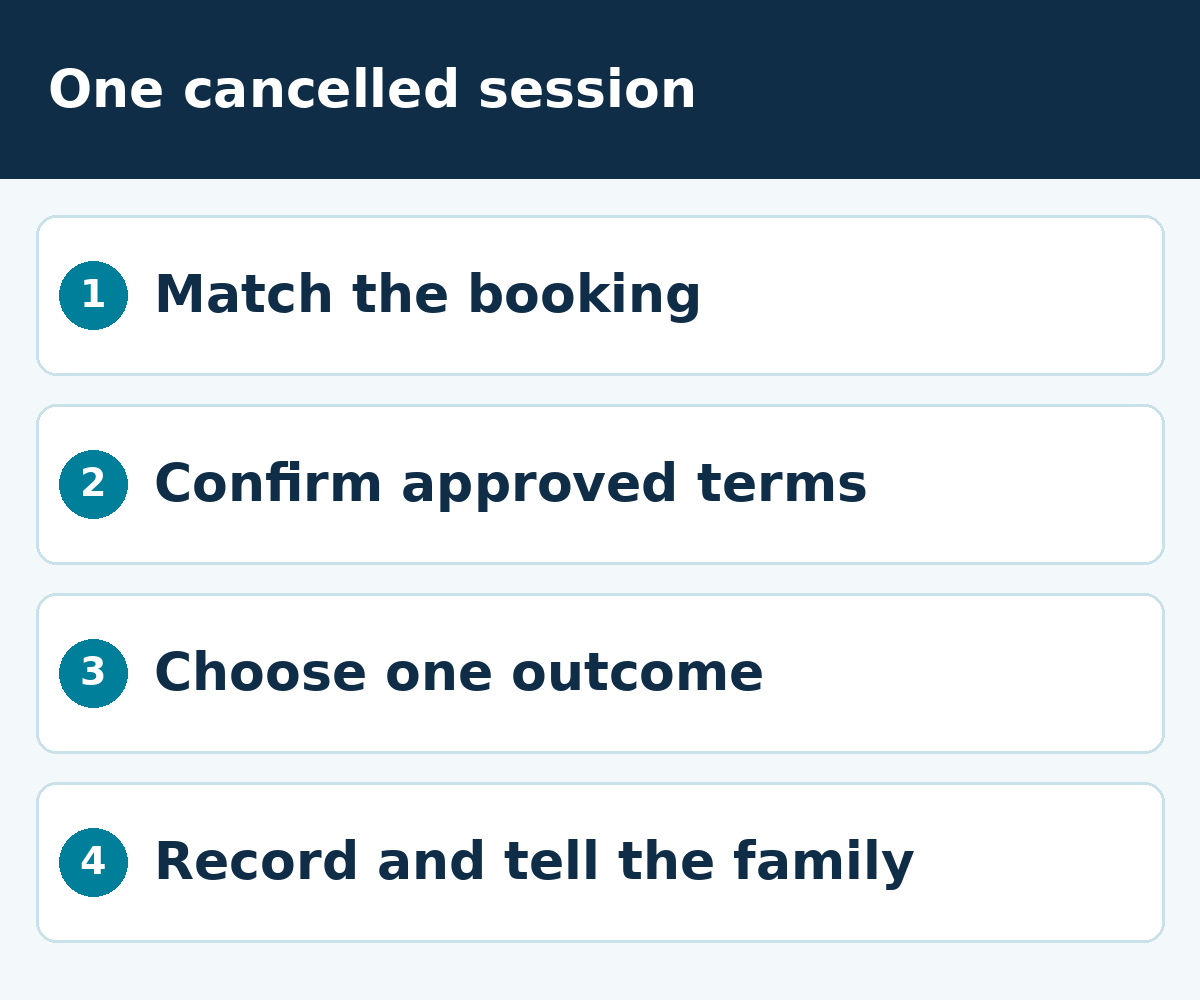
Keep three possible outcomes distinct
A make-up session changes when the service is delivered. Check the replacement date, space, instructor, and whether the family accepted it. An offered place is not the same as a confirmed booking. Decide how long an offer remains open and what staff should do when the family cannot attend.
An account credit leaves value for an approved future use. Tell the family where it appears and how the club's terms allow it to be used. Do not assume it can be transferred between children, applied to dues, or exchanged for cash. If the club permits those choices, record the applicable decision and make the explanation consistent across channels.
The right outcome comes from the booking terms and the circumstances. This is a workflow to carry out that decision consistently, not a replacement refund policy. Have the person responsible for your terms resolve unclear cases before staff offer a remedy.
Give the desk a short answer it can use
Prepare a response that covers the session, the decision, the next step, and where to ask for help. For example: “Wednesday's 4 PM lesson was cancelled. We are contacting enrolled households about the approved replacement session. Your original booking remains on our review list, and the program coordinator will follow up by Friday.”
That response works only if Friday is a real commitment with an owner. Set a follow-up point the team can meet. If the decision is delayed, send a useful update instead of letting the first promise expire silently. Say what is still being checked and when the family will hear from the club again.
For completed adjustments, be equally specific: “We applied the approved $30 lesson credit to your household account. It relates to the September 12 session. Contact the office if the account view does not match this message.” Use the actual amount and terms for that family. A clear explanation does not need a long technical description.
Follow one cancellation all the way through
Take a six-session lesson package costing $180. Under this example club's approved terms, one cancelled session receives a $30 credit. The package record shows five sessions delivered and one cancelled. The coordinator confirms the affected booking and asks the authorized finance user to apply the credit.
Finance records the $30 against that booking, checks the resulting account view, and returns the reference to the coordinator. The coordinator sends the family the outcome and marks the communication complete. The cancellation stays visible in the program record, while the financial adjustment remains traceable to the original purchase.
Now change one detail: the family already accepted a make-up session. The reviewer catches that before issuing the credit and checks which outcome the terms provide. Staff do not give both remedies merely because the booking and account lists were reviewed by different people. The shared reference is what lets them notice the conflict.
Use this sequence in a staff practice session. Ask one person to act as the coordinator and another as the account reviewer. Let them find the records and explain the outcome in their own words. Any point that requires a private message to “the person who knows” belongs in your procedure.
Set approval boundaries before the busy day
Write down which ordinary adjustments staff may process, who reviews exceptions, and who covers that role when the usual approver is away. Keep the authority narrow enough to understand. A staff member should not have to guess whether a small amount makes an otherwise unusual refund acceptable.
Give exception requests a short structure: the original booking, the relevant terms, the family's request, the proposed outcome, and the question needing a decision. Include earlier action already taken. A request that omits an existing credit can lead an approver to decide from an incomplete picture.
Record the answer where the people completing the work can see it. An approval in a personal text message is difficult for the next shift to follow. If approval occurs outside the main record, transfer the decision and its reference into the approved record before completing the adjustment. Keep sensitive details restricted to the people who need them.
Reconcile the list before calling the job finished
At the end of the review, every affected booking should have a clear position. Use practical labels such as awaiting decision, make-up offered, make-up confirmed, credit recorded, refund submitted, or closed with no adjustment under the approved terms. Avoid a single “done” checkbox that hides which outcome occurred.
Compare the list with the account actions. Check for a booking with two remedies, an approved credit that never posted, and a refund whose message was sent before submission. Investigate differences before sending a final batch of confirmations. Keep unresolved items assigned rather than hiding them in a completed report.
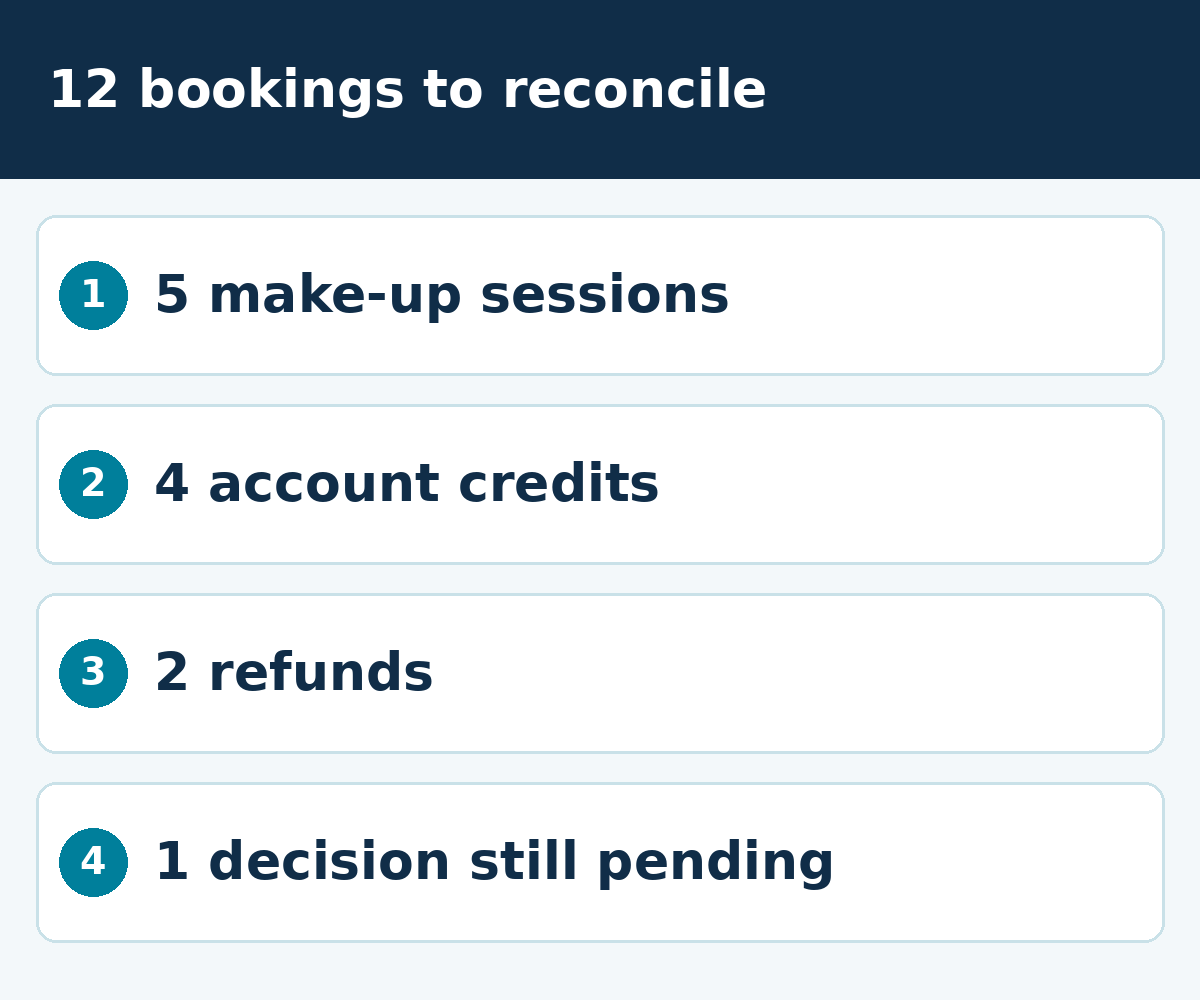
For a simple review total, count affected bookings and group them by outcome. If twelve bookings were affected, the categories should explain all twelve without counting the same booking twice. Keep amounts separate from counts. A total of twelve adjustments says nothing about whether the right households received the right amounts.
Handle the awkward cases deliberately
If a family does not answer a make-up offer, follow the club's stated process for reminders and expired offers. Do not treat silence as acceptance unless the terms support that treatment. Keep the original booking on the review list until the next action is settled.
If an account has a disputed balance, route the case to the person responsible for account decisions. Avoid automatically using a lesson credit to settle a different charge without checking the applicable terms and authorization. The family should receive an explanation that names the charge and the adjustment rather than a mysterious new total.
If staff entered the wrong adjustment, use the approved correction process and preserve the relationship to the original action. Do not cover the mistake with a second unexplained entry. Record what was wrong, what corrected it, and what the household should now see. If the first message was inaccurate, send a corrected explanation.
If the cancellation happened near season end, decide how the open work will be handed over. A credit awaiting review should not disappear when the seasonal coordinator leaves. Assign a year-round owner and a review date, with enough context that the next person can finish the case without calling the departing employee.
Test the platform with the whole case
PoolPulse's published billing page describes recurring charges, credits, and payment collection tied to member records. Use those documented capabilities as the starting point for a cancellation walkthrough, then test your club's exact approvals and account outcome in the proposed configuration. Review PoolPulse billing and payments .
Bring a package booking, a single-session booking, and a case already assigned a make-up. Ask where staff record the cancellation, how the financial reviewer finds it, and what the family sees afterward. Do not stop at creating a credit. Follow the case through review, communication, and reconciliation.
Ask to see the task using the access your coordinator and finance staff will actually have. Check which actions require a manager, what history remains available, and how an incorrect adjustment is corrected. A useful demonstration gives you answers about the work between roles, as well as the visible transaction.
Put the lesson into next season's preparation
After the affected families are handled, review the process with the coordinator and office. Which question needed repeated explanation? Where was the original charge hard to find? Did staff know who could approve an exception? Choose the specific instruction, field, or handoff that needs improvement.
Keep the communication review connected to your end-of-season operational debrief . The closure notice tells families what has changed today. The account follow-up tells them what happens next. They should agree on the affected session without trying to carry every detail in one oversized announcement.
Before the next program opens, check that the registration terms, staff instructions, and family messages describe the same process. Use one ordinary cancellation to rehearse it. Keep the rehearsal focused on finding the booking, applying the approved outcome, and leaving a record another employee can understand.
A closeout checklist for the coordinator
- Confirm the exact session and preserve the affected roster.
- Check the original booking, payment, and any action already taken.
- Apply the club's approved terms and route unclear cases for a decision.
- Keep make-up bookings, credits, and refunds distinct.
- Record the approval and the completed action with a shared booking reference.
- Tell each household what happened and what, if anything, remains pending.
- Reconcile every affected booking and assign the unresolved cases.
- Update the staff instructions before the next registration cycle.
The practical goal is simple: a family asks about a cancelled lesson, and whoever answers can find the same clear outcome. Book a PoolPulse walkthrough and bring one cancellation your team wants to handle more smoothly, from the original booking to the final account check.

Before You Sell Guest Passes for 2027, Decide What They Actually Allow
Build a club guest pass policy staff can apply consistently, covering sponsors, limits, payment, exceptions, records, and opening-day testing.

Before You Approve Your 2027 Club Budget, Count the Work Between Your Systems
A practical way to expose the software, labor, handoff, and transition costs that ordinary budget lines miss.

The Repair Was Reported. Who Checked That It Was Finished?
Make repair handoffs clear with named owners, agreed completion evidence, recorded verification, and useful staff instructions.
Want to see if PoolPulse is a good fit for your club?
Book a walkthrough and we'll show you exactly how PoolPulse can help based on your club's needs, goals, and current processes.