

The Repair Was Reported. Who Checked That It Was Finished?
Make repair handoffs clear with named owners, agreed completion evidence, recorded verification, and useful staff instructions.


The gate repair is marked complete, but the opening employee still finds a note saying it sticks. A contractor has visited, an invoice has arrived, and several people have discussed the problem. None of those records clearly says who checked the finished work or whether the gate is ready for its intended use.
This is a practical handoff framework for ordinary club maintenance administration. It does not replace qualified technical inspection, manufacturer instructions, or the people responsible for facility safety. Its purpose is to make the club's decisions and evidence understandable to the next person who opens the building.
Start with a report another person can locate
A useful request identifies the exact place, the observed problem, and when it was noticed. “Gate broken” leaves too much work for the recipient. “East tennis court pedestrian gate catches at the lower corner when closing” gives the assigned person a starting point without pretending the reporter has diagnosed the cause.
Ask for a reference that stays with the request. Include an appropriate photograph when it clarifies the location or condition, and avoid including members, access codes, or private information in the frame. A close view of the hardware and a wider view of its location may answer different questions. Label them accordingly.
Record what the reporter actually observed. Separate that from a proposed explanation. “The handle moves without opening the latch” is an observation. “The entire lock needs replacing” may be a diagnosis requiring someone qualified to assess it. Keeping the distinction visible helps the club send the right question to the right person.
Decide who needs to respond before assigning a repair
Have the designated facility lead review the request under the club's procedures. Some reports can join a routine work list. Others need immediate escalation, restricted access, or specialist assessment. Staff should follow the established route instead of inventing a severity rating because the form requires a choice.
Make the immediate operating decision explicit. Is the area available, unavailable, or subject to a defined restriction while assessment occurs? Who made that decision, and who needs to know? Record the answer where opening staff will see it. A maintenance note buried in a contractor email is a poor substitute for a clear operating instruction.
Do not ask the front desk to decide technical suitability from a photograph. Give staff a reachable contact and a fallback when that person is unavailable. The administrative system should carry the decision and its owner; it should not turn a dropdown selection into evidence that somebody performed a competent assessment.
Define what completion will mean
Before the work starts, write a short outcome statement. For the gate example, it might refer to the specific issue identified by the responsible assessor and the required checks after the work. Use that person's requirements rather than inventing a generic test that may be unsuitable for the equipment.
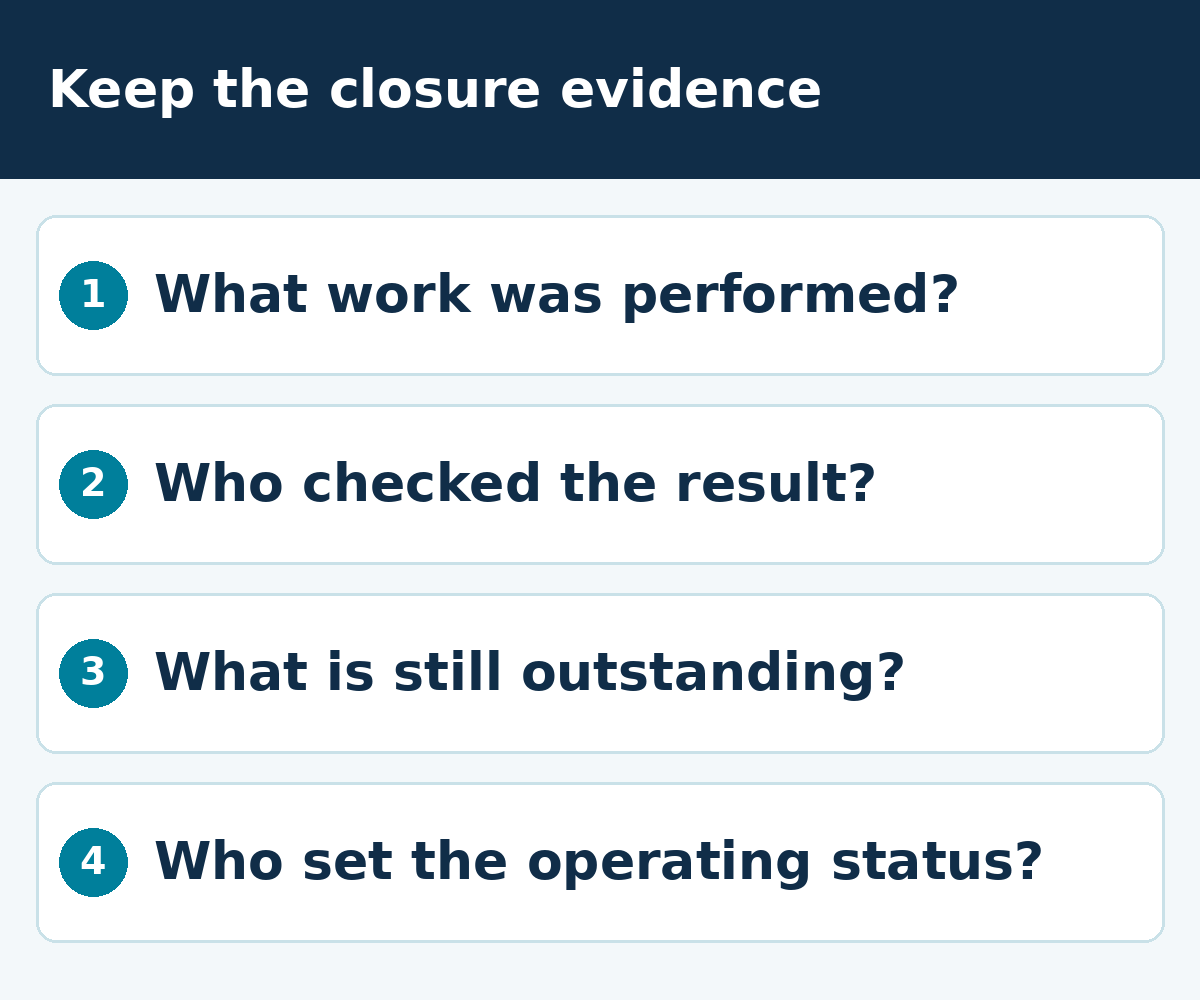
Agree what evidence the club expects from the person doing the work. That could include the work performed, parts used, remaining limitations, relevant documentation, and who should answer follow-up questions. The exact record will depend on the job. A simple adjustment and a specialist replacement do not need identical paperwork.
Keep the handoff states understandable
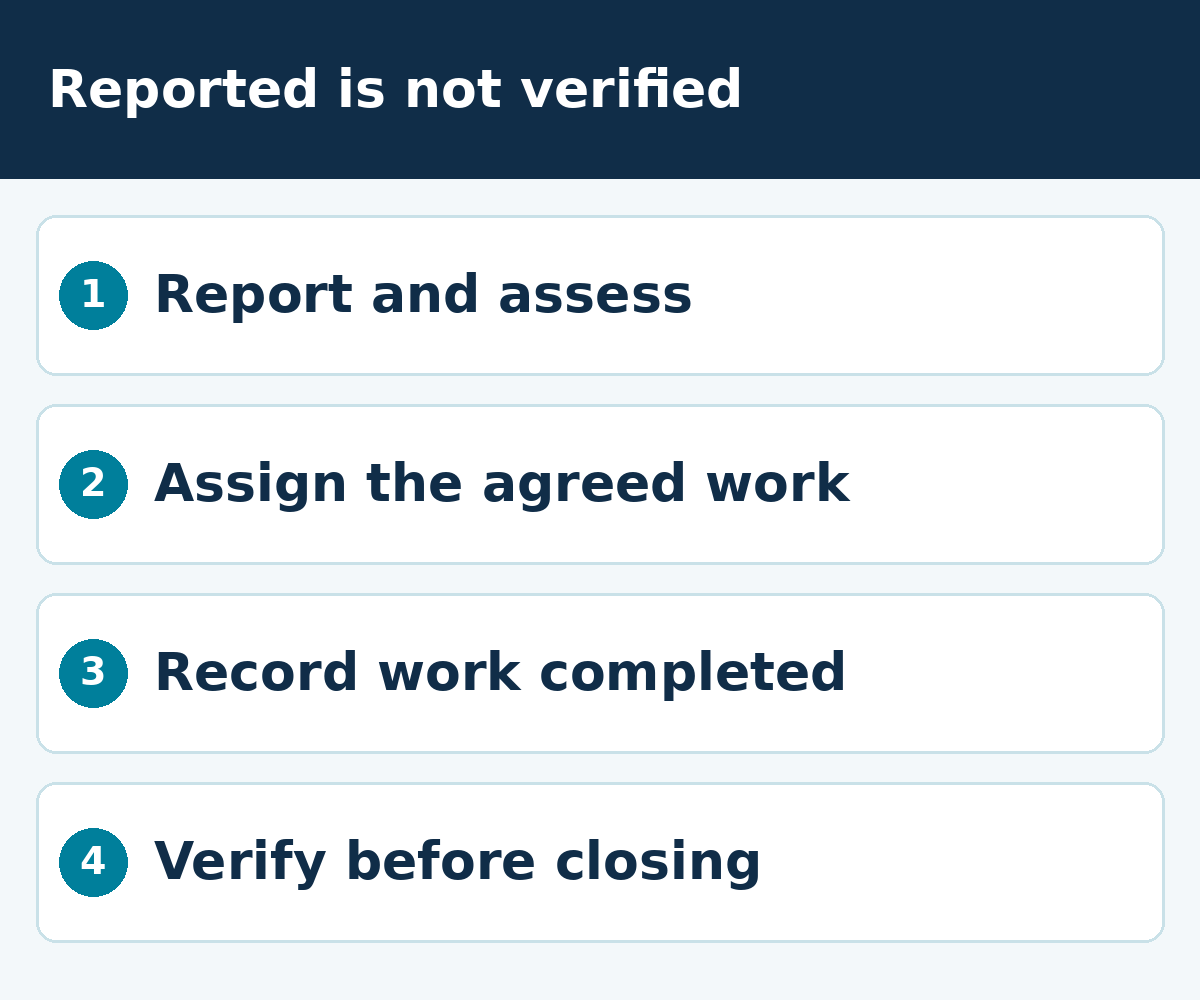
Use a small set of statuses that describe what happened. Reported means the club received the request. Assigned means a person or provider accepted responsibility for the next step. Work reported complete means that person says the agreed work is finished. Verified means the required review occurred and its evidence is recorded.
Closed should mean the request has met the club's completion conditions, including any operating decision and communication. A closed record can still preserve a separate follow-up task if the club deliberately accepted an interim solution. The important part is to describe that choice rather than hide it behind a reassuring label.
Avoid adding statuses nobody can explain. If employees disagree about the difference between “resolved” and “complete,” simplify the vocabulary or write a plain definition beside it. A status system is useful when it helps the next employee choose an action. Extra labels are not a substitute for a named owner and a clear next step.
Follow an ordinary request through one realistic example
Imagine a club reports a loose sign beside a storage entrance. The facilities coordinator records its location, photograph, and the observed movement. Following the club's procedure, the responsible person decides how the area should be managed while the sign is assessed. The request receives a reference and an assigned owner.
The maintenance provider assesses the issue and agrees the work with the coordinator. After completing it, the provider records the work performed and any limitations. The coordinator does not close the request merely because the visit appears on the calendar. They arrange the agreed review and attach its outcome to the same reference.
The reviewer records what was checked, when, and whether anything remains open. The authorized person then records the operating decision. Opening staff receive a short update identifying the location and the current instruction. The original request, work note, review, and communication now form one understandable sequence.
Change one detail: the provider reports that a replacement part is still outstanding. The coordinator records the temporary arrangement and the remaining job separately. The request does not become an unqualified “complete” simply because some work occurred. The next owner can see what remains, who is following up, and when to check again.
Separate the invoice from the condition of the asset
An invoice can tell the club what a provider charged. It does not, by itself, answer every question about the finished condition or the club's operating decision. Link the invoice to the request, but keep payment approval and work verification visible as distinct steps in your own process.
This separation also helps when the work changes. If an assessment leads to a different repair than originally requested, record the approved scope change and its reason. The reviewer should compare the result with the agreed work, not an outdated description from the first report. Preserve the earlier record so the change remains understandable.
When finance asks whether a charge can be processed, the facilities owner should be able to identify the relevant approval and unresolved questions. Avoid making finance reconstruct technical conversations. Equally, avoid treating a payment status as permission to reopen an area. Each decision should stay with the person authorized to make it.
Give opening staff the operational answer
The opening team needs a concise instruction, not the whole repair file. State the location, current operating status, any applicable restriction, and the contact for questions. Include the time of the update so staff can distinguish it from an older notice that is still pinned behind the desk.
Choose one place for the current instruction and make its owner responsible for replacing outdated versions. If the club uses a shift briefing, include the reference there. If a restriction affects member bookings or access, have the responsible team update those arrangements through the club's normal process.
Ask the receiving employee to explain the instruction back during a practice handoff. Can they identify the right location? Can they tell whether the area is available? Do they know whom to contact if the observed condition differs from the note? Treat confusion as a reason to improve the record, not as proof that the employee was inattentive.
Make recurring problems visible without inventing a diagnosis
When a similar issue returns, link the new report to the earlier request. Record the new observation and date. Do not simply reopen the old description without explaining what changed. A repeat report may warrant a different assessment, but that judgment belongs with the appropriate responsible person.
A monthly review can look for repeated locations, incomplete handoffs, and requests that remain assigned without a next date. Those are administrative patterns the club can act on. Ask whether the owner needs information, whether a provider response is pending, or whether the remaining task was never clearly assigned.
Keep conclusions proportional to the evidence. Three reports about one entrance do not automatically prove the same component failed three times. Review the descriptions and completed work before combining them. The purpose of the review is to decide the next useful question, not to produce a dramatic count for a board slide.
Choose records that will survive a staff change
Use an asset or location name that new employees can recognize. A nickname understood by one long-serving manager is not enough on its own. Add a map reference, room name, or equipment identifier where that makes the record clearer, and keep the naming consistent with the club's existing documentation.
Store the request, work details, and verification evidence in the authorized place. Give people access appropriate to their role. Avoid copying sensitive access information into a general work log merely to make it convenient. If a provider needs restricted information, use the club's approved method for sharing it.
Include unresolved work in the season handover. For each item, name the current owner, next action, outstanding dependency, and review date. Your end-of-season club debrief can identify which handoff problems deserve attention before next season. Keep the operational work list specific enough for someone to pick up without another meeting.
Evaluate the workflow before choosing a tool
Take one fictional request through the complete process during a demonstration or internal trial. Ask the person reporting it to create the record. Ask a second person to find it, understand the assignment, and locate the current operating instruction. Then test whether a reviewer can distinguish work reported complete from verification completed.
Use fictional information and an ordinary, non-sensitive example. Do not upload real access details or private staff records to a demonstration environment. Give the participants a clear task and observe where they need help. NIST describes usability testing as evaluating a product or service by testing it with representative users ; your club can apply that practical approach to this handoff.
Score the result against your required decisions. Can the club identify the owner, preserve the evidence, and communicate the current instruction? What still requires another system or manual step? Do not award points simply because a screen contains a maintenance-themed icon. The useful question is whether your actual work can be completed and understood.
Put the platform conversation in its proper place
PoolPulse describes a platform covering areas such as membership, payments, reservations, staff scheduling, and reporting on its current feature pages. Use those documented areas to frame the broader club operations conversation. Confirm any specific maintenance workflow, integration, or record requirement directly rather than assuming it is available because other club information is connected.
Bring your example request and completion conditions to that conversation. Ask where each decision would be recorded, who could access it, and how the next shift would find the current instruction. If a separate maintenance system remains appropriate, understand the handoff between it and the club's other work before deciding what to change.
Close one real gap this week
Choose a recently completed ordinary request and trace it from the original observation to the final operating instruction. Look for the work record, the agreed review, the named decision-maker, and the message to staff. If something is missing, assign the appropriate person to resolve that specific gap through the club's existing process.
Then update the template so the next request asks for the information at the right stage. Keep reporting easy, assignment explicit, and closure meaningful. A useful maintenance record is one that lets the next person understand what happened, what was checked, and what they are expected to do now.
To explore how this handoff fits alongside your club's wider operations, book a PoolPulse demo and bring one example request to walk through.

Before You Sell Guest Passes for 2027, Decide What They Actually Allow
Build a club guest pass policy staff can apply consistently, covering sponsors, limits, payment, exceptions, records, and opening-day testing.

Before You Approve Your 2027 Club Budget, Count the Work Between Your Systems
A practical way to expose the software, labor, handoff, and transition costs that ordinary budget lines miss.

Before Renewal Opens, Explain Every Household Credit
Prepare for renewal by tracing household credits to their source, checking remaining value, and recording approved actions.
Want to see if PoolPulse is a good fit for your club?
Book a walkthrough and we'll show you exactly how PoolPulse can help based on your club's needs, goals, and current processes.