

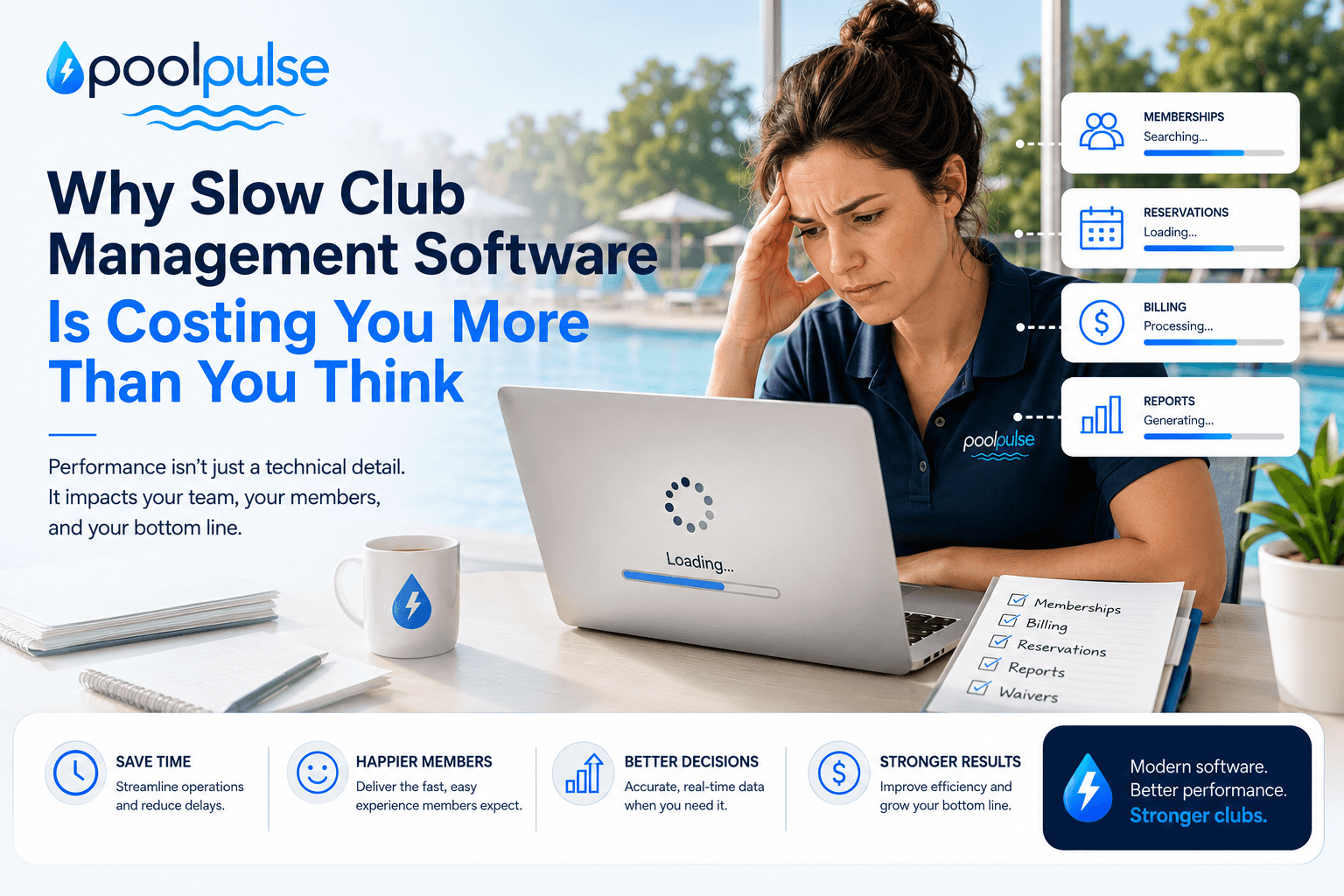
Why Slow Club Management Software Is Costing Your Club More Than You Think
Slow club management software impacts more than convenience. It affects staff productivity, member satisfaction, support workloads, and revenue. Learn the hidden costs of slow systems and what modern club software should deliver.

When club administrators evaluate software, the conversation usually revolves around features.
Can it manage memberships?
Can it process payments?
Can members register online?
Can it handle reservations and waivers?
Those are all important questions.
But there is another factor that often gets overlooked until it starts causing daily frustration:
Performance.
The reality is that slow club management software affects far more than convenience. It impacts staff productivity, member satisfaction, reporting accuracy, revenue collection, and ultimately the overall perception of your organization.
Many clubs spend thousands of dollars every year on software that technically does everything they need, but takes too long to do it.
The result is a constant stream of small frustrations that compound over time.
The Hidden Cost of Waiting
A five-second delay doesn't sound significant.
Until it happens hundreds of times per day.
Imagine a typical day at a busy swim club.
A staff member:
- Looks up memberships
- Processes guest passes
- Checks members in
- Reviews billing records
- Searches reservation history
- Answers member questions
- Runs reports
If every action requires waiting, even briefly, the lost time accumulates quickly.
A delay of just five seconds repeated 300 times per day equals 25 minutes of wasted staff time.
Over a week that's more than two hours.
Over a season that's dozens of hours spent staring at loading screens.
Most clubs never calculate these costs because they happen gradually.
But staff feel them every day.
Slow Systems Create More Work
One of the most overlooked consequences of poor software performance is the additional work it creates.
When systems become slow, people stop trusting them.
Staff begin creating workarounds.
You start seeing:
- Excel spreadsheets
- Printed reports
- Sticky notes
- Manual tracking systems
- Duplicate record keeping
Instead of becoming the source of truth, the software becomes one more place staff have to check.
This creates new problems:
- Data inconsistencies
- Duplicate information
- Reporting errors
- Missed payments
- Administrative confusion
Ironically, the software purchased to improve efficiency begins reducing it.
Members Expect Better Experiences
Club members compare your digital experience to every other digital experience they use.
They compare it to:
- Their bank
- Online shopping platforms
- Streaming services
- Airline apps
- Food delivery apps
That may not seem fair.
But it's reality.
Members don't care why a portal is slow.
They only notice that it is.
When a member logs in to pay dues, view reservations, register for programs, sign waivers, or access family information, they expect the experience to be fast and intuitive.
A slow portal creates friction.
Friction creates frustration.
Frustration creates support requests.
Support requests create more work for staff.
The cycle repeats.
Peak Season Is When Problems Become Visible
Many software systems perform adequately during quiet periods.
The real test comes when usage spikes.
For swim clubs, that often means:
- Opening weekend
- Membership renewals
- Program registration periods
- Summer events
- Holiday weekends
This is precisely when staff need software to perform its best.
Unfortunately, many platforms struggle under increased demand.
Pages take longer to load.
Reports take longer to generate.
Member searches become slower.
Check-in processes become bottlenecks.
The busiest days of the year become the most frustrating.
Why Older Platforms Often Slow Down
Most software doesn't start slow.
It becomes slow.
Over years of development, systems accumulate technical debt.
Features get added.
Integrations get bolted on.
Workflows evolve.
Databases grow.
The platform becomes increasingly difficult to maintain and optimize.
Legacy Architecture
Many club management systems were originally designed years ago.
Technology standards have changed dramatically since then.
What worked well ten years ago may struggle to meet modern expectations.
Database Growth
As membership records, transactions, reservations, and historical data accumulate, poorly optimized databases become slower.
Simple searches become increasingly expensive.
Reports take longer to generate.
Administrative workflows suffer.
Too Many Dependencies
Many platforms rely heavily on third-party plugins and integrations.
Every dependency introduces additional overhead.
When enough layers accumulate, performance suffers.
Infrastructure Limitations
Some platforms simply outgrow the infrastructure they were originally built on.
Without modernization efforts, speed eventually becomes a casualty.
The Business Impact of Slow Software
Slow software doesn't just waste time.
It costs money.
Directly and indirectly.
Consider the following:
- Lost staff productivity
- Increased support requests
- Lower member portal adoption
- Reduced member satisfaction
- Higher administrative burden
- More manual processes
- Greater risk of data inconsistencies
These costs rarely appear on a balance sheet.
But they're very real.
Questions Every Club Should Ask Their Software Provider
If you're evaluating a platform or considering a switch, ask:
- How does the platform perform during peak season?
- How large is the average client database?
- What is the average page load time?
- How often are performance optimizations performed?
- How is new code tested before release?
- How are outages prevented?
- What happens when usage spikes?
Many clubs focus entirely on features.
The better question is:
Can your team actually use those features efficiently?
What Modern Club Software Should Deliver
Today's club management platform should provide:
Fast Access to Information
Staff should find what they need immediately.
Responsive Member Portals
Members should be able to complete tasks without frustration.
Real-Time Reporting
Reports should help decision-making, not create delays.
Reliable Performance
Busy days should feel no different than quiet ones.
Continuous Improvement
The platform should evolve without disrupting daily operations.
How PoolPulse Approaches Performance
When we built PoolPulse, we knew speed couldn't be treated as an afterthought.
Club administrators already juggle memberships, billing, reservations, communications, waivers, reporting, and day-to-day operations.
The software shouldn't become another challenge to manage.
That's why PoolPulse was designed with separate development, testing, beta, demo, and production environments, allowing new features to be validated before reaching live clubs and helping maintain stability and performance for organizations using the platform.
Our goal has always been straightforward:
- Fast member searches
- Responsive billing workflows
- Smooth check-in experiences
- Efficient reporting
- Reliable member portals
- Scalable infrastructure
Because great software should disappear into the background.
It should help your team work faster, not constantly remind them that it's there.
The Bottom Line
Most clubs don't realize how much time they lose to slow software until they experience something faster.
The problem isn't usually one major delay.
It's hundreds of small delays happening every day.
Over time, those delays affect staff productivity, member satisfaction, operational efficiency, and revenue.
When evaluating club management software, don't just ask what features it includes.
Ask how quickly your team can use them.
Because the difference between a system that responds instantly and one that constantly makes people wait can have a bigger impact on your organization than any feature list ever will.
Your club deserves software that keeps up with your team.
Not software that slows it down.

Fully Booked, Half Empty? Fix Your Club’s Court Reservation Policy
A full booking calendar can still leave courts unused. Connect cancellation, arrival, release, and exception rules so members have a fair chance to play.

Beyond the Tech: How Modern Startups Are Revolutionizing Club Operations Safely
Modern club startups are reshaping operations with safer workflows, clearer access controls, stronger payment visibility, audit trails and security-forward design.
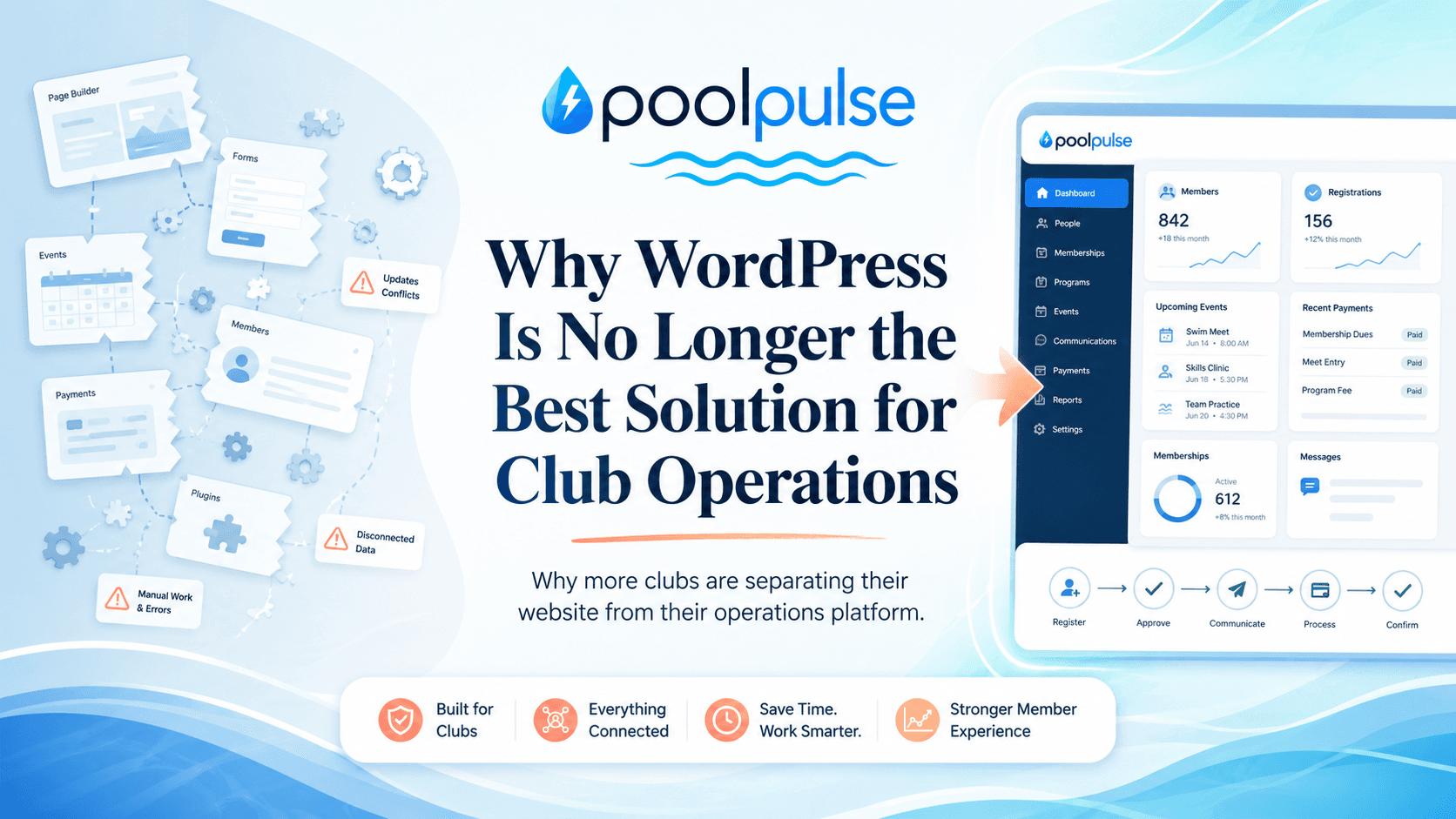
Why WordPress Is No Longer the Best Solution for Running Your Club Operations
A practical look at why growing clubs should keep WordPress focused on marketing and move memberships, billing, waivers, check-ins and reporting into a purpose-built platform.
Want to see if PoolPulse is a good fit for your club?
Book a walkthrough and we'll show you exactly how PoolPulse can help based on your club's needs, goals, and current processes.