

Your Membership Revenue Report Is Not Reconciled Until These Four Numbers Agree
Stop treating a payment total as a revenue answer. Reconcile the full path from member charge to bank deposit with a four-number framework your board can trust.


The treasurer sees a healthy bank deposit, the membership administrator sees unpaid invoices, and the board wants one revenue number. None of those views can settle the question alone. Before reporting membership revenue, trace the charges, account adjustments, payments, and bank settlement through the same reporting period.
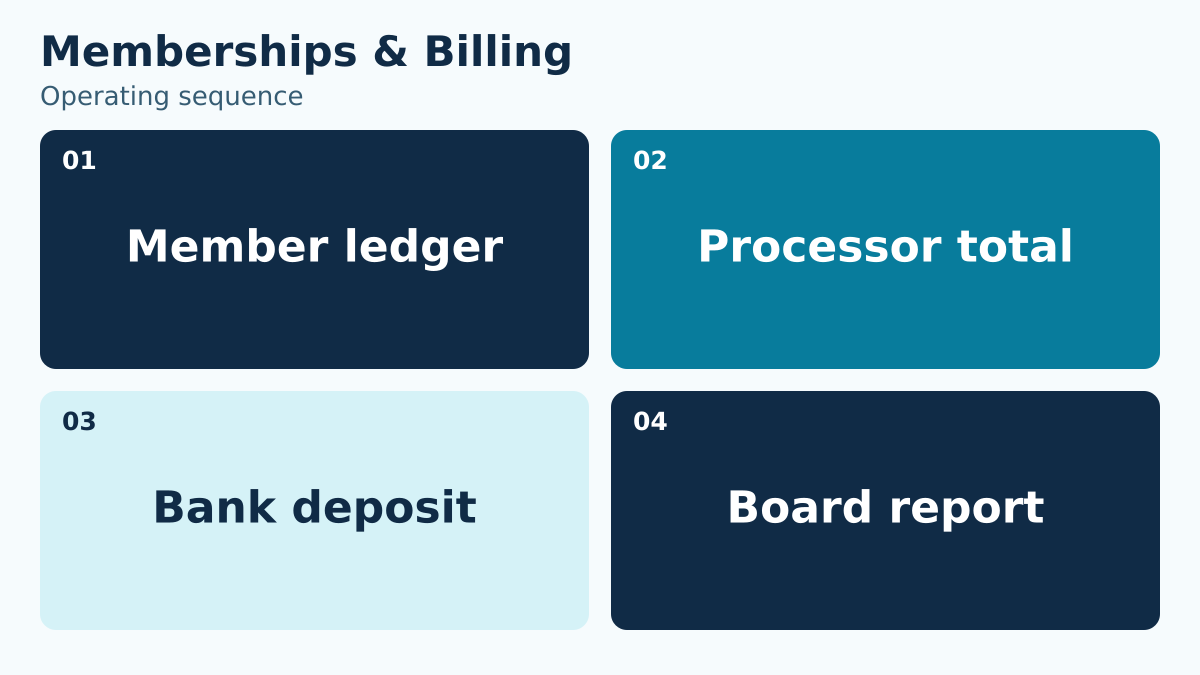
The practical answer is a four-part reconciliation: prove what members owed, explain credits and other adjustments, match collections to member accounts, and bridge those collections to deposits. The four figures need to reconcile through an explanation; they do not need to be identical. Keep revenue recognition and tax treatment with your accountant while using the operating review below to make the underlying records dependable.
For federal tax records, the IRS says a business may use any recordkeeping system that clearly shows income and expenses; the specific records needed depend on the business. Review the IRS recordkeeping guidance . PoolPulse connects dues, one-time charges, payments, and household context in its billing and payments workspace .
Start with the obligation, not the deposit
List what the club actually charged during the period. Separate recurring dues, initiation fees, program charges, guest fees, adjustments, and one-time items so a healthy deposit total cannot hide a bad fee rule or a missing charge.
Use a charge register with a stable category, service period, household, posting date, and responsible rule. If staff cannot explain why an amount appeared, the report is not ready.
Consider a club that expects 100 households to renew at $600. A $60,000 target is only a planning assumption until staff establish which households were actually billed. Suppose five households deferred renewal and three received approved $100 reductions. The charge register should distinguish the 95 issued charges from the expected roster, then show the $300 reduction separately. Otherwise, someone comparing cash with the original target might label a policy decision as a collection failure. Start the review with counts as well as dollars: eligible households, charges issued, exclusions, and approved changes. Give each exclusion a reason and an owner. A missing invoice and an intentionally deferred invoice may have the same immediate dollar effect, but they demand different follow-up. Resolve that distinction before calling families about payment.
Separate cash movement from earned revenue
A processor payout is cash movement. Use the provider’s payout reporting guidance to identify the transactions and adjustments that explain a settlement; do not assume the deposit equals the charges issued in the same period. Keep the operating question and accounting question separate.
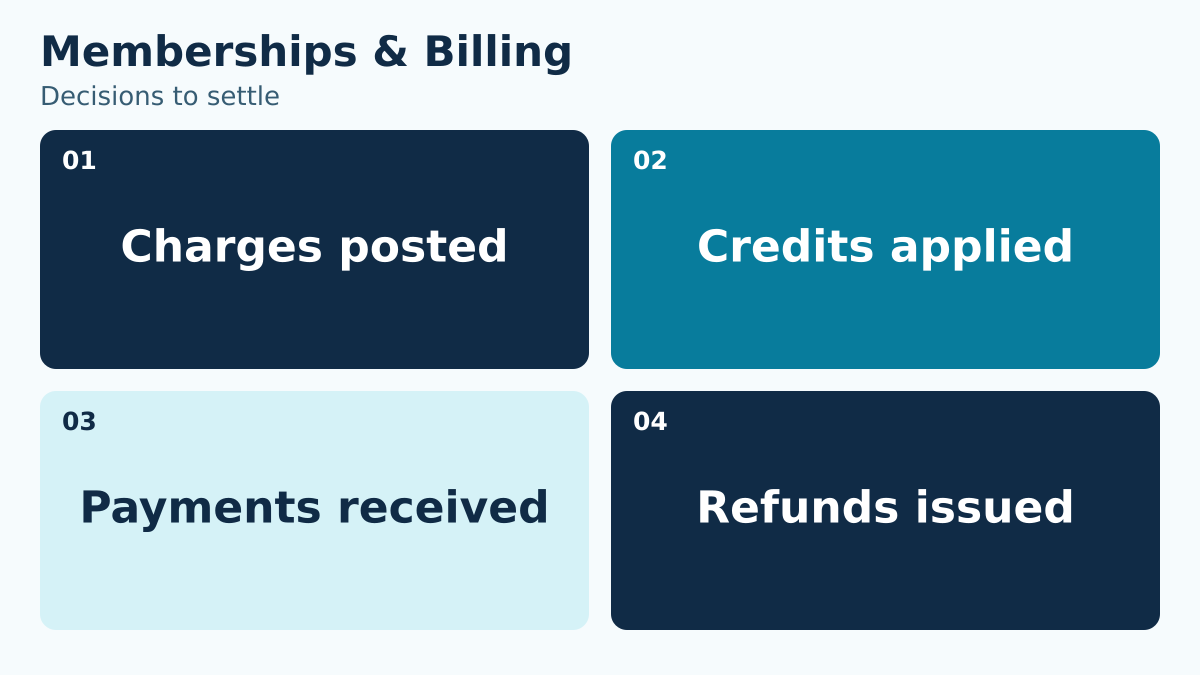
Build a bridge that shows opening receivables, charges, credits, payments, refunds, write-offs, and closing receivables. The bridge should explain every change without forcing the treasurer to infer what happened.
Use two worksheets when the question requires two answers. The member-account worksheet explains obligations and remaining balances; the settlement worksheet explains where collected cash went. For a simple operating example, begin with $2,000 outstanding, add $10,000 of charges, subtract $500 of approved credits and $8,000 of payments applied to those charges. The resulting balance is $3,500. This example assumes no other movements. A separate payment received for next season belongs in its own review category rather than being forced into this calculation. Label the scope above the worksheet, including period, included charge types, and treatment of advance payments. Ask the accountant to decide how the operational categories map into financial statements. That separation lets administrators reconcile accurately without pretending an account export answers every accounting question.
Make credits visible instead of netting them away
A credit may be correct, but it changes the story. Group credits by reason: cancellation, service recovery, duplicate payment correction, scholarship, board-approved exception, or policy adjustment.
Require a reason and an approving role for material credits. The goal is not suspicion; it is to preserve a record that the next manager can understand without reopening old email threads.
Give a reviewer enough context to distinguish a commercial decision from an administrative repair. A duplicate invoice correction should point to the duplicate and the surviving invoice. A scholarship adjustment should point to the authorized award without exposing unnecessary personal details in the board packet. A cancellation credit should identify the applicable club policy and the affected service period. Use separate reason codes even if all three reduce the household balance. Then review unusual combinations: a large credit followed by a cash refund, multiple small credits entered on the same account, or a credit posted after a period was closed. These are questions to resolve, not allegations. Ask the preparer to explain the sequence and preserve the answer beside the adjustment so a future treasurer does not have to repeat the investigation.
Reconcile processor activity to bank deposits
Match each processor settlement to the bank deposit it created, including fees, timing differences, chargebacks, and refunds. Treat unmatched items as an exception queue with an owner and due date.
Do not force a difference into a miscellaneous category to make a report balance. A small unexplained difference repeated every month becomes an operating blind spot.
Build the settlement bridge from identifiable transactions, not a guess at the expected net deposit. In a simplified example, $8,000 collected less $200 of refunds and $240 of fees produces $7,560 before other adjustments. If the bank shows $6,560, leave a visible $1,000 difference until the settlement evidence explains it. A dated amount still awaiting deposit is different from a payment that cannot be located. Give each unmatched item a transaction reference, amount, expected destination, age, and next check. Do not use the word reconciled for the whole batch while a material unexplained difference remains. Review actual provider settlement details because timing and deductions depend on the arrangement; Stripe’s payout reporting guidance distinguishes reporting options for automatic and manual payouts.
Tie totals back to member accounts
Select representative households and trace the full path from fee rule to invoice, payment, credit, status, and ledger history. Include a straightforward renewal, a partial payment, a refund, and an account with an approved exception.
This sample-based review tests whether the total is supported by understandable member-level evidence, not merely whether two summary cells match.
A total can pass arithmetic checks while the wrong household bears the balance. Trace a deliberately varied sample rather than selecting only clean accounts. For example, follow one family that renewed normally, one that split a payment, one that changed membership category, and one that cancelled after paying. Write the expected ending balance before looking at the final screen. Compare the charge description, participant or household, applied payment, adjustment reason, and member-facing explanation. If $600 was received but attached to the wrong family, the bank total will not reveal that error. Expand the review around the affected payment method or import batch when a sample exposes a pattern. Keep the sample selection and findings with the close packet so the next review can focus on new risks instead of repeating the same convenient accounts.
Define the board view
Boards need a decision-ready view: billed revenue, collected cash, outstanding balances, credits and refunds, exceptions, and comparison to plan. They do not need an unfiltered transaction dump.
Add short explanations for material variances and identify the action or decision required. A useful dashboard answers what changed, why, who owns it, and what happens next.
Design the board page around questions directors can act on. Show the period’s charges, credits, applied collections, closing balances, and settlement differences with clear definitions. Put the reconciliation bridge immediately below the headline figures. Add a short exception note such as: “Two renewal charges require correction; finance will review them Thursday. The related households have been excluded from collection reminders pending review.” In this example, the note explains the operational response without publishing family details. Avoid a single unexplained collection percentage: specify whether its denominator is current-period charges, all open invoices, or the full-season target. Use the club board dashboard checklist to connect each measure to an owner and a decision. Keep sensitive account-level detail in the supporting finance review, not the general board presentation.
Close the period with named evidence
Set a close date, responsible preparer, reviewer, exception threshold, and sign-off record. Preserve the exported report, reconciliation bridge, unresolved exception list, and approval note together.
When the next report begins, carry forward only documented open items. This prevents the same unexplained amount from becoming a permanent fixture.
Make the sign-off a small, reproducible package. Include dated exports, the calculation that connects opening and closing balances, the settlement bridge, adjustment approvals, and the unresolved-item register. Record the extraction time as well as the reporting period so reviewers know which later edits are absent. Give the reviewer a short set of checks: totals agree with the source exports, adjustments have explanations, samples support the balances, and open differences have owners. If a correction arrives after sign-off, retain the original packet and document the replacement or subsequent-period treatment. Do not silently swap an export and leave the board comparing two versions with the same filename. A clear version name and correction note preserve the chain from the report originally discussed to the numbers now being used.
Use the result to improve policy
Reconciliation is also operational feedback. Repeated credits may point to confusing cancellation rules; repeated manual adjustments may reveal a fee catalog problem; delayed deposits may expose a handoff gap.
Turn recurring exceptions into a short improvement backlog. Fix the rule or workflow that creates the exception instead of accepting a monthly cleanup ritual.
Choose one recurring exception to remove from next month’s workload. If families repeatedly receive credits because the renewal form displays the wrong category, correct the form and test the charge produced by each category. If deposits are difficult to match because records lack settlement references, add that reference to the finance handoff. If staff repeatedly explain the same balance question, revise the invoice description and confirmation message. Define a small success test before making the change: the next sample should produce the intended charge, show a usable reference, or require no manual explanation. Review the next close against that test. Keep the improvement list short enough to finish; a long backlog of vague billing concerns does less for the club than one verified correction that prevents a known class of error.
Use this working-session checklist
- Name the reader or staff role who must make the decision.
- Write the operational question in one sentence.
- Identify the source record and the person responsible for it.
- Define the normal path and the most common exception.
- State which role can approve an override or correction.
- Choose the evidence that proves the outcome was completed.
- Set a review date and a trigger for revisiting the rule.
- Test the process with a realistic household, staff account, or operating day.
Do not mark the work complete because a document exists. Ask someone who did not write it to use it. If that person cannot reach the correct outcome without private coaching, the process still depends on memory.
How to make the decision durable
Write the final rule in language a seasonal employee can understand. Put technical configuration details in the implementation record, not in the staff instruction. Connect the policy to the screen, report, or record staff actually use, and give exceptions a visible route instead of an informal favor.
Then review the first few real cases. Compare the expected result with what staff and members experienced. Correct wording, permissions, fields, or training while the evidence is fresh. A small early review is more useful than a large annual cleanup because it catches interpretation gaps before they become habits.
Finally, keep ownership visible. Every open item needs a person and a date. “The board,” “the office,” or “the vendor” is not an owner. A role or named person who can act is.
Turn the framework into an operating advantage
The purpose of this work is not a perfect document. It is a club that can answer a member, complete a shift, prepare a report, and hand responsibility to the next person without losing context. Clear records reduce the number of situations that require heroic memory.
PoolPulse billing and payment workflows can help keep the relevant account and operational context connected. The club still owns its policies, approvals, and judgment; the platform should make those decisions easier to apply and review.
See PoolPulse billing and member-ledger workflows in a personalized walkthrough.

Freeze, Cancel, or Defer? Give Staff One Membership Answer
Separate membership freezes, cancellations, and deferrals with clear dates, financial treatment, access rules, approvals, and member communication.

A Club Dashboard Is Not a Report Dump. It Should Answer These Seven Questions.
Design a club board dashboard around decisions, definitions, ownership, and follow-up instead of filling meetings with disconnected exports.
How to Reconcile Club Payments Without Spending Hours in Spreadsheets
A practical guide for clubs that want cleaner payment records, faster reconciliation, and fewer financial reporting headaches.
Want to see if PoolPulse is a good fit for your club?
Book a walkthrough and we'll show you exactly how PoolPulse can help based on your club's needs, goals, and current processes.