

Your Offseason Repair List Is Too Long. Here Is How to Decide What Moves First.
A decision framework for turning a long offseason repair list into owned, timed, and verifiable work.


By October, a seasonal club can have a list that includes paint, pumps, gates, lighting, storage, signage, deck furniture, technology, and dozens of small complaints collected during summer. Sorting by who asked most recently creates motion, not a reliable opening plan.
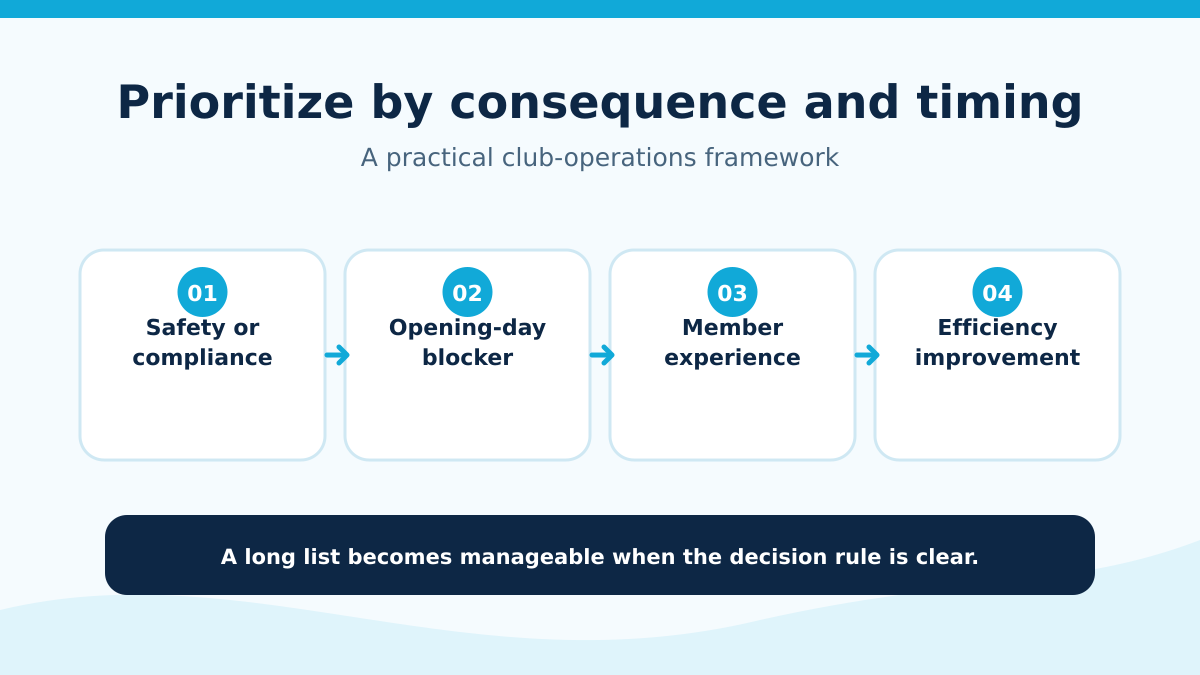
Use two decisions. First, route safety, compliance, and technical suitability to the appropriately responsible or qualified people. Second, for ordinary planning, rank work by opening-day dependency, member impact, lead time, cost uncertainty, and whether another project depends on it.
The matrix does not replace technical judgment. It helps the manager and board decide ownership, sequence, funding, and verification without disguising every request as equally urgent.
Build the decision around the club’s real work
The strongest plan starts with one ordinary transaction, the people who touch it, the rules they apply, and the record that should remain when the work is done. Use the sections below as a working session with the employees and volunteers who run the process. Write down assumptions, unresolved questions, and owners as you go.
1. Normalize the list before ranking it
“Fix pool,” “replace lock,” and “clubhouse looks tired” are not comparable requests. Give each item a location, observed condition, requested outcome, reporter, date, and any current operating restriction.
Keep observations separate from diagnoses. A reporter can describe what happened without deciding which part or remedy is required.
Questions to answer:
- Where is it?
- What was observed?
- When was it observed?
- What outcome is requested?
- Is a restriction already in place?
Leadership reviews understandable work items instead of ranking vague phrases.
2. Route responsibility before scoring
Some items require the club’s designated safety process, a licensed trade, manufacturer guidance, or another qualified review. Do not let a numeric score substitute for that route.
Record who determines the immediate operating status, who assesses the work, and who receives the result. Staff should know what they can report and what they must escalate.
Questions to answer:
- Who owns the operating decision?
- Is qualified assessment needed?
- What guidance applies?
- Who can authorize work?
- Who needs the outcome?
The priority process supports responsible decisions instead of pretending the spreadsheet made them.
3. Identify opening-day dependencies
An item becomes operationally critical when another required task cannot proceed without it. A room must be accessible before equipment can be installed; member records must be ready before access tests; a vendor decision may precede training.
Draw the dependency chain and mark the latest acceptable completion date. Prioritize the earliest blocker, not merely the most visible final task.
Questions to answer:
- What depends on this?
- What must happen first?
- What is the latest safe date?
- Is access required?
- What contingency exists?
The schedule protects the sequence of work that makes the club usable on opening day.
4. Separate member impact from internal convenience
Some improvements directly affect access, program availability, or a member’s ability to understand and use the club. Others reduce staff effort or improve appearance. Both can matter, but the board should see the difference.
Describe the practical consequence and the affected group. Avoid invented savings or dramatic language. When impact is uncertain, state what will be observed or tested.
Questions to answer:
- Who is affected?
- What can they not do?
- Is the effect recurring?
- Can a workaround serve?
- How will improvement be checked?
Tradeoffs become clearer because every item carries an honest purpose.
5. Add lead time and cost confidence
A modest item with a long procurement or permitting lead may need an earlier decision than a more expensive task that can be scheduled quickly. Record estimate quality, dependencies, access windows, and responsible vendor contact.
Use ranges or pending labels when cost is not confirmed. Separate authorization to obtain a proposal from authorization to perform the work.
Questions to answer:
- What is the lead time?
- How confident is the cost?
- What approval is needed?
- When can work occur?
- What could delay it?
The board can act on timing without mistaking an early estimate for a final commitment.
6. Assign an owner and next date
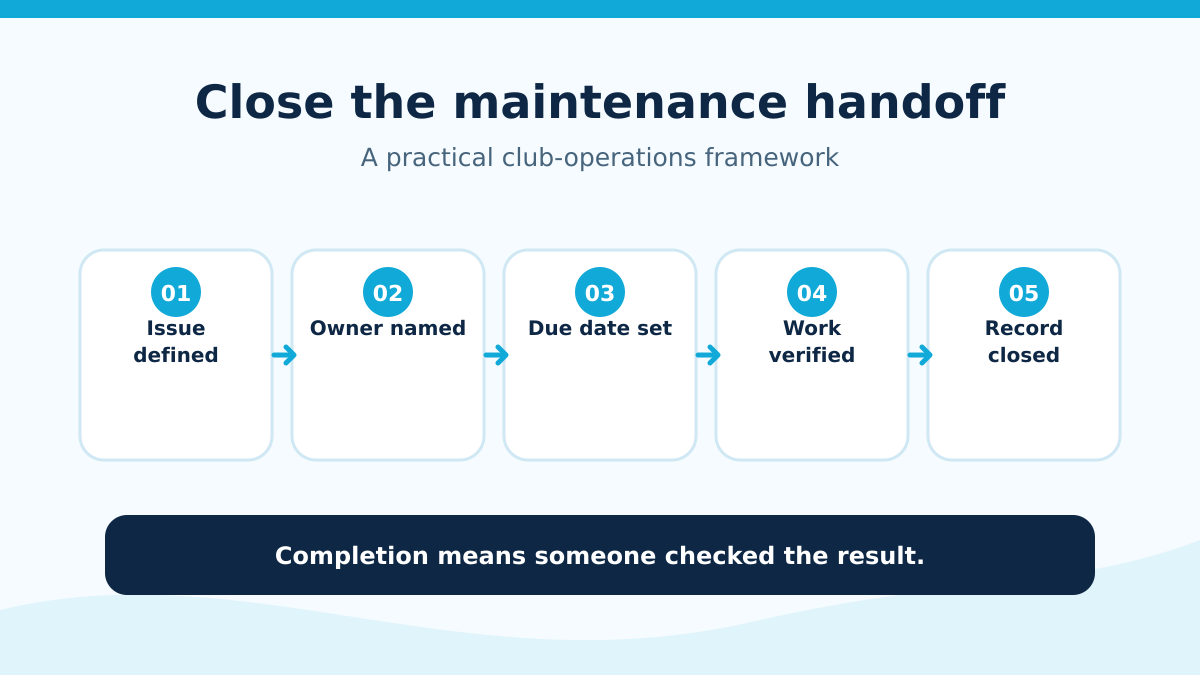
A priority without ownership is an opinion. Give each active item one person responsible for the next step and one date when progress will be reviewed. The owner may coordinate rather than perform the work.
Keep waiting states explicit: awaiting proposal, awaiting assessment, scheduled, work reported complete, verification pending, or closed.
Questions to answer:
- Who owns the next step?
- What is that step?
- When is it due?
- What is it waiting for?
- Who follows up?
Stalled work becomes visible before it threatens the calendar.
7. Verify the result before closing
A paid invoice or contractor visit is not the same as a verified outcome. Define the completion evidence before work begins and name the person authorized to review it.
Record what was checked, when, remaining limitations, and the current operating decision. Keep finance approval distinct from technical or operational verification.
Questions to answer:
- What proves completion?
- Who checks it?
- What remains open?
- Can the area operate?
- Who receives the update?
The club knows what is actually ready and what still requires attention.
Follow one realistic club example
A club has a faded sign, a gate that sometimes sticks, new storage shelves, and a pump-room lighting request. Instead of assigning all four to one “urgent” list, the manager routes the gate and lighting through the proper assessment path, identifies the gate as an opening dependency, schedules the shelves around room access, and treats the sign as a member-experience improvement with a later decision date. Every item receives an owner, evidence requirement, and review date.
Use the example as a rehearsal, not as a promised result. Replace its assumptions with your club’s approved rules, actual volumes, responsible people, and operating calendar. The goal is to make the next decision observable: another staff member should be able to tell what happened, why it happened, and what must happen next.
A practical readiness checklist
- Give each request a location and observed condition.
- Separate observation from diagnosis.
- Route safety, compliance, and technical questions appropriately.
- Identify opening-day dependencies.
- Describe member and staff impact proportionately.
- Record lead time and cost confidence.
- Distinguish proposal approval from work approval.
- Assign one owner and next date.
- Define completion evidence before work begins.
- Keep invoice approval and operational verification separate.
Keep a decision ledger beside the working plan
A checklist shows whether a task is complete; a decision ledger shows why the club chose the rule behind it. For each material choice, record the question, the approved answer, the approving role, the effective date, the source document or meeting, and any condition that would require another review. Keep the language brief enough that the people operating the process can use it.
The ledger is especially useful when reasonable people remember the discussion differently. It prevents a draft suggestion, an old exception, or a vendor demonstration from quietly becoming policy. If no authorized decision exists, mark the item open and name the person responsible for bringing it to the correct group. “Open” is a useful status; it is better than a confident answer nobody actually approved.
Include the decisions that feel obvious today. Staff changes, board turnover, and the pressure of a busy season can make an unwritten assumption expensive to reconstruct. A new employee should be able to see which rule applies, when it began, and where to ask for a change. Archive superseded versions instead of deleting them so the club can explain historical records under the policy that existed at the time.
Review the ledger from the perspective of club managers, facilities leads, and boards. The operational owner should confirm that the answer can be carried out. Finance should confirm how money or reporting is affected when relevant. The member-facing owner should confirm that the explanation is understandable. A short cross-role review often exposes a gap that a longer single-department meeting misses.
Rehearse the handoff, not just the happy path
Choose one ordinary case and one difficult case, then let the people who will run the process complete it from beginning to end. Give them the approved rule and sample information, but do not coach every click or conversation. Watch where they pause, switch tools, ask for permission, or create a side note. Those pauses reveal where the operating design still depends on memory.
For the difficult case, change one condition that matters: a deadline has passed, a balance conflicts, an eligible person becomes ineligible, a staff member lacks access, or the expected record cannot be found. The purpose is not to surprise employees. It is to confirm that the process provides a safe next step when the routine path stops. Staff should know what they may decide, what they must escalate, and how to leave a useful record for the next person.
Ask another employee to pick up the saved result without hearing the rehearsal conversation. Can they identify the current state, the last decision, the responsible owner, and the next date? If they must call the original employee to understand the record, improve the labels, notes, ownership, or workflow before launch. A handoff is successful when context survives the shift change.
Repeat the rehearsal after a material correction. Testing the edited version matters because a fix in one place can create inconsistency somewhere else. Re-read the member message, account or work record, report, and staff instruction together. The club is ready when the same approved answer remains visible across the complete journey.
Measure the first cycle without inventing a success story
Decide in advance what the club will observe during the first cycle. Useful measures may include incomplete cases, unresolved exceptions, repeat contacts, manual corrections, processing time, or the number of records waiting for an owner. Choose only measures that the club can define and collect consistently. A small trustworthy set is more useful than a dashboard filled with ambiguous counts.
Pair counts with a review of the underlying cases. A rise in questions may mean the message is unclear, the policy is new, or members are paying closer attention; the number alone does not identify the cause. Read representative records, talk with the employees doing the work, and separate a policy gap from a training need, a data problem, and a product defect before choosing a response.
Set a review date and an owner for each measure. During the review, keep completed changes separate from recommendations. Record what evidence supports the conclusion, what remains uncertain, and whether the next step requires management or board approval. Do not claim saved money, retained members, or better performance unless the club has a sound baseline and a method that supports that conclusion.
The most useful outcome of the first cycle may be a narrower rule, a clearer message, or a better exception route. Treat those corrections as part of operating the process, not as evidence the plan failed. A practical system makes learning visible and controlled while preserving the decisions that still apply.
Connect the decision to one operating record
PoolPulse keeps setup progress, readiness checklists, and remaining launch work visible as clubs prepare to go live. Explore the relevant PoolPulse workflow .
A connected platform does not remove the need for policy, ownership, or judgment. It should make the approved rule easier to execute, keep the result beside the member or operating record, and give the next authorized person enough context to act. Ask to see the complete journey—including an exception—using sample information that matches the club’s real process.
For a related operating exercise, use the repair closeout checklist .
Choose the next step
Assign one person to complete the checklist, one person to review it from another role, and one date for the next decision. Keep unknowns visible. If a material question remains unanswered, make resolving it the next gate instead of treating silence as approval.
Schedule a PoolPulse walkthrough to see how operational readiness can stay visible alongside the club workflows your opening plan depends on. Schedule a personalized PoolPulse walkthrough . You can also review current PoolPulse pricing before the conversation.

Before Bookings Open, Decide What “Available” Actually Means
Turn facility availability into enforceable booking rules covering capacity, eligibility, prime time, guests, cancellations, and check-in.

Opening Day Is the Wrong Place to Start Your Renewal Calendar
A practical renewal calendar that works backward from opening day and gives every milestone an owner and release gate.

Your Data Made It. Is Your Club Ready?
A successful upload proves that records arrived. This five-part readiness test shows whether household relationships, balances, waivers, access rules and real club workflows survived the move.
Want to see if PoolPulse is a good fit for your club?
Book a walkthrough and we'll show you exactly how PoolPulse can help based on your club's needs, goals, and current processes.