

Your Waitlist Is Not a Spreadsheet Problem. It Is a Policy Decision.
A practical waitlist policy that helps clubs fill openings without making families or staff decode an improvised queue.


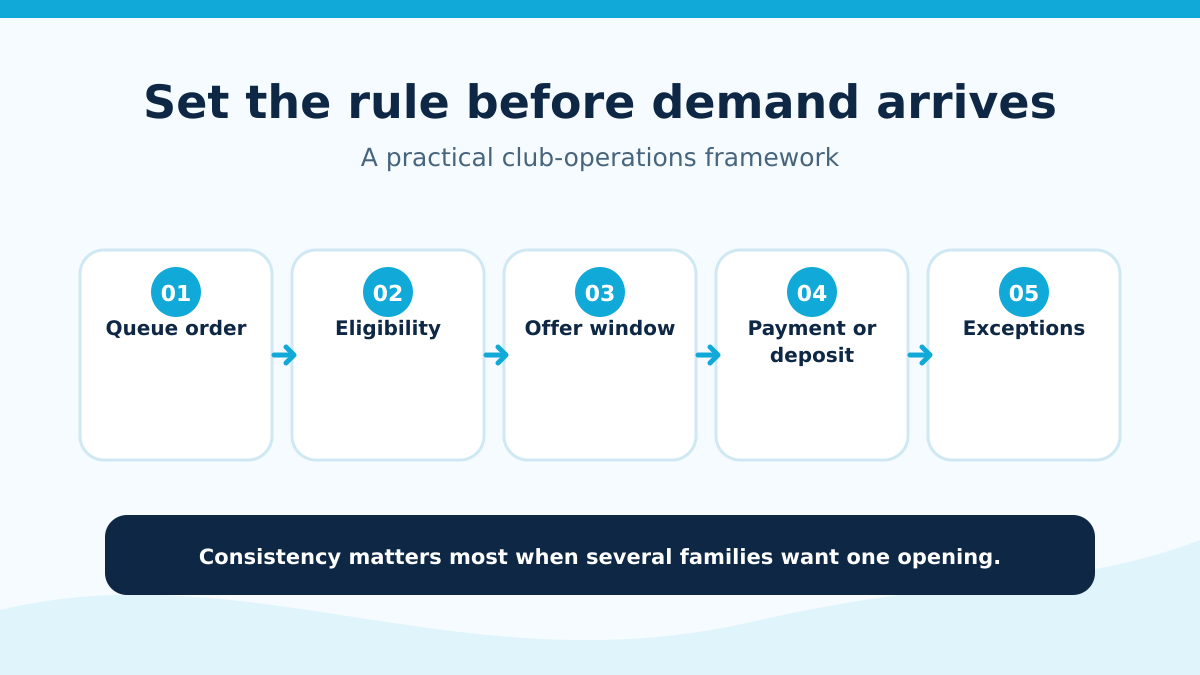
A waitlist looks simple until one spot opens and several families believe it should be theirs. The spreadsheet can sort dates. It cannot decide whether siblings receive priority, whether an unpaid account remains eligible, how long an offer stays open, or who may approve an exception.
Those are policy decisions. Make them before registration starts, then configure the list and messages around the approved rules. A clear policy protects staff from improvising under pressure and gives families a process they can understand even when the answer is not the one they hoped for.
This framework works for memberships, lessons, clinics, courts, and other capacity-limited offerings. Adapt it to the club’s governing documents and approved enrollment terms.
Build the decision around the club’s real work
The strongest plan starts with one ordinary transaction, the people who touch it, the rules they apply, and the record that should remain when the work is done. Use the sections below as a working session with the employees and volunteers who run the process. Write down assumptions, unresolved questions, and owners as you go.
1. Define exactly what the queue is for
A single “waitlist” can accidentally mix different products. Separate membership types, program sessions, age groups, times, facilities, and other constraints that determine whether an opening is actually suitable.
Give each queue a name staff and families can recognize. State whether a person may join several related queues and whether accepting one offer removes them from others.
Questions to answer:
- What capacity is limited?
- Which offering owns the queue?
- Can people join multiple queues?
- What removes someone?
- Who maintains the definition?
Every opening points to a defined group of potentially eligible people instead of a broad list staff must reinterpret.
2. Choose the order rule
First-come, first-served is common, but it is still a policy choice. Some clubs use returning-member windows, sibling rules, residency, program prerequisites, or lottery methods. The method must be approved and capable of being explained.
Write the tie-breaker and the timestamp that controls order. If the club changes the rule, preserve the effective date rather than silently re-sorting people who joined under a different promise.
Questions to answer:
- What determines position?
- What breaks a tie?
- Does priority expire?
- Can position change?
- How are rule changes handled?
The queue can be reproduced and audited when a family asks why another person received an offer first.
3. Check eligibility at useful moments
Eligibility can change between joining and receiving an offer. Decide what the club checks when a person joins, what it checks again when a spot opens, and what happens when documentation or account status is incomplete.
Do not collect unnecessary private information merely to hold a place. Keep the waitlist record limited to what the club needs for the approved decision and route sensitive documents through the appropriate process.
Questions to answer:
- What is checked at entry?
- What is rechecked at offer?
- What can pause eligibility?
- What data is necessary?
- Who resolves uncertainty?
Staff know whether an ineligible record is paused, removed, or escalated instead of skipping it without explanation.
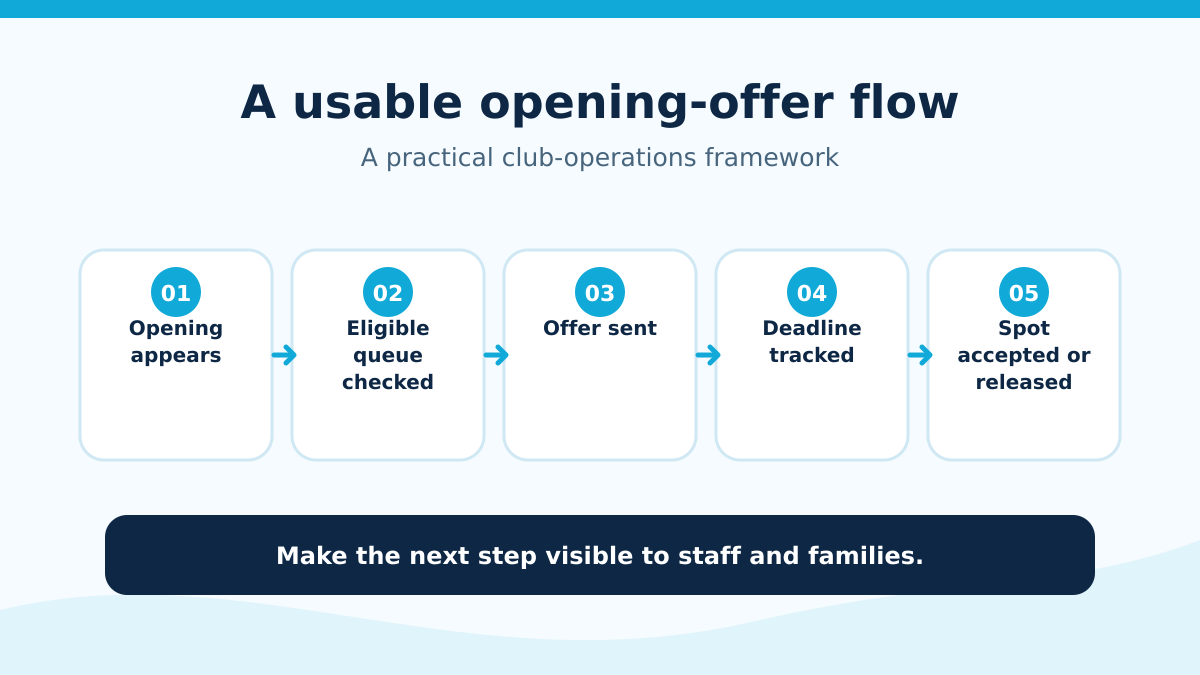
4. Set an offer window that staff can run
An offer needs a start time, an expiration time, a delivery method, and a rule for weekends or closures. “Respond quickly” creates different deadlines depending on who sends the message.
Choose a window suited to the offering and the club’s operating schedule. State whether acceptance alone holds the spot or whether payment, deposit, forms, or approval must also be complete.
Questions to answer:
- When does the clock start?
- How is the deadline shown?
- What counts as acceptance?
- What happens after expiry?
- Are closures treated differently?
The team can release an expired spot consistently without waiting for a manager to reconstruct the conversation.
5. Write the payment and deposit rule
A deposit may confirm commitment, but the amount, due date, refund treatment, and ledger destination must be clear. If no payment is required, say what action converts the offer into a confirmed place.
Test the complete sequence from offer through charge, payment, expiration, and refund or release. Make sure the member message and finance record use the same terms.
Questions to answer:
- Is payment required?
- Is a deposit refundable?
- Where is it recorded?
- What if payment fails?
- Who can extend the deadline?
Capacity and money move together through an understandable process rather than through side notes.
6. Limit exceptions and name the authority
Emergencies and unusual circumstances happen. A good policy does not pretend they never will; it defines who can approve a departure, what must be recorded, and how the queue is repaired afterward.
Avoid letting whoever answers the phone make a permanent change. Give staff a compassionate response and a clear escalation path while preserving the approved order until a decision is made.
Questions to answer:
- What can be appealed?
- Who decides?
- What record is required?
- Does an exception move others?
- How is the outcome communicated?
Families receive consistent treatment and staff are not pressured to invent authority they do not have.
7. Test the first five openings before launch
Run sample cases: a normal acceptance, an expired offer, an ineligible first person, a failed deposit, and an approved exception. Use sample data and ask the employee who will actually operate the queue to perform each handoff.
PoolPulse keeps waitlist queues tied to memberships, programs, and reservation slots , with demand tracking and faster opening offers. Test the exact ordering, timing, and payment behavior your policy requires.
Questions to answer:
- Can staff locate the queue?
- Can they see the deadline?
- Can they explain a skip?
- Can finance trace payment?
- Can the next opening proceed?
The club finds policy gaps while they are still easy to fix and opens registration with a rehearsed process.
Follow one realistic club example
A lesson program has one opening. The first family joined months ago but no longer meets the session’s age requirement; the second family is eligible; the third is a sibling of a current participant. Without a policy, the coordinator faces three plausible answers. With the policy, eligibility is rechecked at offer time, sibling priority applies only during a defined registration window, and the second family receives a time-limited offer. The record shows why, when, and what happens next.
Use the example as a rehearsal, not as a promised result. Replace its assumptions with your club’s approved rules, actual volumes, responsible people, and operating calendar. The goal is to make the next decision observable: another staff member should be able to tell what happened, why it happened, and what must happen next.
A practical readiness checklist
- Create a separate queue for each real capacity constraint.
- Publish the ordering rule and tie-breaker.
- Define eligibility at entry and at offer.
- Limit the data collected to what the decision needs.
- Set the offer start, deadline, and delivery route.
- Define acceptance, deposit, and payment failure.
- State what expiration does.
- Name exception authority and required notes.
- Rehearse five ordinary and difficult cases.
- Review filled, expired, skipped, and unresolved offers after launch.
Keep a decision ledger beside the working plan
A checklist shows whether a task is complete; a decision ledger shows why the club chose the rule behind it. For each material choice, record the question, the approved answer, the approving role, the effective date, the source document or meeting, and any condition that would require another review. Keep the language brief enough that the people operating the process can use it.
The ledger is especially useful when reasonable people remember the discussion differently. It prevents a draft suggestion, an old exception, or a vendor demonstration from quietly becoming policy. If no authorized decision exists, mark the item open and name the person responsible for bringing it to the correct group. “Open” is a useful status; it is better than a confident answer nobody actually approved.
Include the decisions that feel obvious today. Staff changes, board turnover, and the pressure of a busy season can make an unwritten assumption expensive to reconstruct. A new employee should be able to see which rule applies, when it began, and where to ask for a change. Archive superseded versions instead of deleting them so the club can explain historical records under the policy that existed at the time.
Review the ledger from the perspective of membership managers and program directors. The operational owner should confirm that the answer can be carried out. Finance should confirm how money or reporting is affected when relevant. The member-facing owner should confirm that the explanation is understandable. A short cross-role review often exposes a gap that a longer single-department meeting misses.
Rehearse the handoff, not just the happy path
Choose one ordinary case and one difficult case, then let the people who will run the process complete it from beginning to end. Give them the approved rule and sample information, but do not coach every click or conversation. Watch where they pause, switch tools, ask for permission, or create a side note. Those pauses reveal where the operating design still depends on memory.
For the difficult case, change one condition that matters: a deadline has passed, a balance conflicts, an eligible person becomes ineligible, a staff member lacks access, or the expected record cannot be found. The purpose is not to surprise employees. It is to confirm that the process provides a safe next step when the routine path stops. Staff should know what they may decide, what they must escalate, and how to leave a useful record for the next person.
Ask another employee to pick up the saved result without hearing the rehearsal conversation. Can they identify the current state, the last decision, the responsible owner, and the next date? If they must call the original employee to understand the record, improve the labels, notes, ownership, or workflow before launch. A handoff is successful when context survives the shift change.
Repeat the rehearsal after a material correction. Testing the edited version matters because a fix in one place can create inconsistency somewhere else. Re-read the member message, account or work record, report, and staff instruction together. The club is ready when the same approved answer remains visible across the complete journey.
Measure the first cycle without inventing a success story
Decide in advance what the club will observe during the first cycle. Useful measures may include incomplete cases, unresolved exceptions, repeat contacts, manual corrections, processing time, or the number of records waiting for an owner. Choose only measures that the club can define and collect consistently. A small trustworthy set is more useful than a dashboard filled with ambiguous counts.
Pair counts with a review of the underlying cases. A rise in questions may mean the message is unclear, the policy is new, or members are paying closer attention; the number alone does not identify the cause. Read representative records, talk with the employees doing the work, and separate a policy gap from a training need, a data problem, and a product defect before choosing a response.
Set a review date and an owner for each measure. During the review, keep completed changes separate from recommendations. Record what evidence supports the conclusion, what remains uncertain, and whether the next step requires management or board approval. Do not claim saved money, retained members, or better performance unless the club has a sound baseline and a method that supports that conclusion.
The most useful outcome of the first cycle may be a narrower rule, a clearer message, or a better exception route. Treat those corrections as part of operating the process, not as evidence the plan failed. A practical system makes learning visible and controlled while preserving the decisions that still apply.
Connect the decision to one operating record
PoolPulse keeps waitlists tied to the memberships, programs, and reservation slots that create demand. Waitlist is offered as a $15 monthly add-on and is included in Plus and Premier. Explore the relevant PoolPulse workflow .
A connected platform does not remove the need for policy, ownership, or judgment. It should make the approved rule easier to execute, keep the result beside the member or operating record, and give the next authorized person enough context to act. Ask to see the complete journey—including an exception—using sample information that matches the club’s real process.
For a related operating exercise, test a platform against one complete club workflow .
Choose the next step
Assign one person to complete the checklist, one person to review it from another role, and one date for the next decision. Keep unknowns visible. If a material question remains unanswered, make resolving it the next gate instead of treating silence as approval.
Schedule a PoolPulse walkthrough with one real queue and test the policy from opening to confirmed spot. Schedule a personalized PoolPulse walkthrough . You can also review current PoolPulse pricing before the conversation.

Want to see if PoolPulse is a good fit for your club?
Book a walkthrough and we'll show you exactly how PoolPulse can help based on your club's needs, goals, and current processes.